Pages

Showing posts sorted by relevance for query charlie and mouse. Sort by date Show all posts

Friday, August 23, 2019

Charlie and Mouse Even Better by Laurel Snyder, illustrated by Emily Hughes

Taylor WorleyOur guest blogger today is Taylor Worley. Taylor (she/her) is a Youth Librarian at Springfield Public Library in Oregon. When she isn’t reading, she can be found drinking tea while stuck in a video game, making something with yarn, or exploring. She has two dogs, Olivander (Oliver) and Gregorovitch (Gregory). You can find her on Instagram or Goodreads @thatonelibrarian.

Charlie and Mouse are back for round three! These two adorable kids leapt onto the early reader scene in 2017 with their debut, Charlie and Mouse. Author Laurel Snyder and illustrator Emily Hughes took home the Geisel Award for that first book in 2018. Since then, readers got to know Charlie and Mouse more in Charlie and Mouse and Grumpy and now in Charlie and Mouse Even Better. Even Better is eligible for the 2020 Geisel Award, but does the third outing stand up to the legacy of the first? 

Cover image: Charlie and Mouse Even Better
Even Better is divided into four short chapters: making pancakes with Mom, gift shopping with Dad, birthday party prep and disaster, and operation “distract mom”/successful birthday celebration. This format, accompanied by Hughes’ distinct illustrations, is consistent throughout the series and is a large part of what makes the titles successful for beginning readers. The chapters are not numbered; they are simply headings that provide a key for the plot’s shifting focus. The text stays tight and straightforward with wide margins and ample line spacing. The illustrations are the epitome of sweet, with bright colors and feathery lines. Commendation must be given to Hughes for her ability to express a vast array of emotions through eyebrows alone!

With the history of the series, there is no denying that Charlie and Mouse are a great resource for beginning readers. The question here, however, is if Even Better reaches that benchmark of “distinguished” above all other beginning reader titles this year. When reading Even Better to a variety of willing participants, one thing particularly caught my attention. My youngest listeners - those entering Kindergarten in fall 2019 - very much enjoyed this title as a read-aloud. They engaged with the pictures, asked questions, and wanted to continue through each page until the end. However, an even slightly older audience quickly lost interest in this title. When surveying families, those with incoming first and second graders unanimously said, “No, my child wouldn’t be drawn to this book.” So, where is the disconnect? 

Interior image from Charlie and Mouse Even Better: Mom making pancake dragons
Charlie and Mouse are young characters, and the cover of Even Better looks, in my sample audiences’ words, “babyish”. The text, however, is more challenging. The disconnect, I believe, is in the presentation of this particular title versus its intended audience. The intended audience is just a touch older than the audience that is enjoying this title as a read-aloud. Consequently, this book struggles to find the sweet spot of “motivating independent reading” while maintaining the “page-turning dynamic.” This doesn’t mean it is a bad book by any stretch, but it does undermine the book’s ability to take home a Geisel for being the “most distinguished” beginning reader title this year.

The TLDR is that Charlie and Mouse Even Better is another warm, fuzzy, and lovely entry in the Charlie and Mouse series. It is a good resource for some, but perhaps not all, beginning readers. It should absolutely be in your libraries, but I would be surprised if it walked away with the gold this year.

Tuesday, June 20, 2017

Charlie & Mouse by Laurel Snyder, illustrated by Emily Hughes


Today's post is by Elisa Gall. She works as Youth Collection Development Librarian at a public library north of Chicago, Illinois. She can be found on Twitter at @gallbrary. 

Arnold Lobel took home a Caldecott honor in 1971 for Frog and Toad Are Friends, and a Newbery honor in 1974 for Frog and Toad Together. There is no rule that says beginning readers are off-limits to “other” award committees besides the Geisel, but Lobel never won a Geisel—the first award wasn’t given until 2006.

The 2018 Geisel Committee can only place Geisel-eligible books up against other books published in the same year, so they aren’t thinking too much about Frog and Toad. I bet they’ll be thinking just a little bit about the amphibian friends though, because the Frog and Toad-ness in Laurel Snyder and Emily Hughes’s Charlie & Mouse cannot be ignored. It’s there in the muted color palette, the short chapters capturing slice-of-life moments, and the tender relationship between two characters who live together. It is subtle, and who knows how intentional, but it hits all the same notes which make it an excellent beginning reader book and book in general. Of all the readers published this year, Charlie & Mouse is the title I could see receiving crossover committee recognition; but, since we have only Charlie & Mouse on the table today, and we’re examining it for the Geisel Award specifically, let’s get to business and look at all of the ways I think it shines through the Geisel lens:

Repetition. 
The repetition here is functional, but not too functional. Words are introduced thoughtfully and in context. Repetition creates predictable pacing (making lines easy to read aloud and with expression) and some humor as well:
     “Now it is time for bed,” said Mom.
     “Not without a story!” said Charlie.
     “No,” said Mom. “Of course not. Not without a bedtime story.”
     She read Charlie and Mouse a bedtime story.
     “Now it is time for bed,” said Mom.
     “Not without a song!” said Mouse.
     “No,” said Mom. “Of course not. Not without a bedtime song.”
     She sang Charlie and Mouse a bedtime song.
    “Now it is time for bed,” said Mom.
    “Not without a banana!” said Charlie.
     “A banana?” said Mom.
     “We need a banana!” said Charlie.
     “You need a banana?”
      Mouse nodded. “Charlie is right,” he said. “We cannot go to sleep without a bedtime banana.”

Illustrations. 
Image from Charlie & Mouse
by Laurel Snyder, illustrated by Emily Hughes
The illustrations are supportive, representing and extending what the text offers relating to plot, setting, and character. For example, the art in the opening pages can help a reader understand that the talking “lump” is actually a person snuggling underneath a bedspread. An illustration of “Sakamoto’s Shave Ice” on page 27 shows that the children’s snack break is inspired by what they see in their neighborhood. There are so many elements of visual storytelling that we would miss if we were only looking at the text. We see the dad looking tired over his cup of coffee. We see the kids’ imaginative outfits during their adventure to the park. We see Charlie and Mouse hunting for money under the couch cushions, and Mom’s surprise when she sees all of the rocks her children have brought home with them. We get depth to the characters’ relationships too, as shown when Charlie gently rubs Mouse’s head as they brush their teeth together. Hughes’s illustrations provide scaffolding for readers working to comprehend the text, but they do so much more.
Image from Charlie & Mouse by Laurel Snyder, illustrated by Emily Hughes

Motivation & Encouragement. 
Image from Charlie & Mouse
by Laurel Snyder, illustrated by Emily Hughes
The textual repetition combines with Hughes’s illustrations to make for nearly-perfect page turns. My favorite page turn of this book appears on page 13, when everyone shouts “Come on!” and the following page reveals a line of children, one after the other, marching along to the park. The next turn reveals a full bleed illustration of the empty park equipment, just waiting for the children to explore it. The larger font size and line spacing also pull readers in, for there is enough room for a finger (or pencil) to rest between the lines as readers track text. The book’s four chapters are short, and start to finish the entire story leaves readers satisfied, but excited for more. (The young readers in my life were sad to see the book end, but content at knowing a sequel is on the way.) And then there are the endpapers. I don’t think grown-ups always realize how much endpapers can intrigue. The mint green endpapers show objects (ice cream cones, wiggly socks, bananas, rocks, and branches) which provide story foreshadowing but fun things to examine regardless.

From a Geisel standpoint, I have no concerns about this book. There is a scene when one of the neighbors holds a cigarette, but if anyone questioned that in deliberations I’d remind them that there are to be “no limitations as to the character of the book considered except that it will be original and function successfully as a book for beginning readers.” The plot, rhythm, and visual storytelling in Charlie & Mouse combine to make a book that is excellent for summer, excellent for siblings, and excellent for beginning readers. What do you think?

Friday, October 15, 2021

Charlie and Mouse Lost and Found by Laurel Snyder


 Charlie and Mouse are back in a 5th book in the series, exploring themes of Lost and Found. Laurel Snyder and Emily Hughes received Geisel Gold in 2018 for the initial entry to the Charlie and Mouse series, about which the committee chair that year compliment the "authentic dialogue, thoughtfully repeated phrases, and distinctive illustrations". But does this latest entry have what it takes to catch the committee's eye? It is tough but not impossible for a series to earn repeat recognition - just take a look at Mo Willems' Elephant and Piggie series. Are the charming Charlie and Mouse among the "most distinguished" again this year?

The opening story jumps right into the repetition that makes this series such a strong choice for beginning readers, as Charlie and Mouse search all manner of "somewheres" for Mouse's missing blanket. The direct sentences give the dialogue a cadence reminiscent of Frog and Toad.

Emily Hughes' illustrations again add to the story, from a depiction of the many somewheres they're searching to the absolutely perfect representation of "nothing fun" at the opening of "Errands".

And then we have it - the ringer on every beginning reader team - a dog! While the Geisel criteria obviously don't require the presence of a dog, there's no denying the success of pups ranging from Henry and Mudge to King and Kayla and of course the protagonist of last year's Geisel Medal winning See the Cat. If connecting to a criteria, I'd say that dogs more often than not speak to "Subject matter must be intriguing enough to motivate the child to read". And with Charlie and Mouse as our examples, we see that the addition of a dog is enough to liven up the dreaded errands.

Laurel Snyder and Emily Hughes paint a clear picture of the impact of a new dog on family life (especially for poor Kittenhead), and the story finds its way to a touching conclusion with one last moment of silliness as it ends on another intriguing subject matter for kids of a certain age - dogs peeing. This story, like others in the Charlie and Mouse series makes sure to call back to the earlier stories in its conclusion - a reward for beginning readers who tackle all four stories in one go. 

This addition to the series is sure to be adored by fans (who could resist the utterly adorable Boop?) Will it be as impressive to the Geisel Committee? We will have to wait and find out. 

Tuesday, June 13, 2017

Design Discussions with Melissa Manlove, Senior Editor at Chronicle Books

Hi Guessers,

Melissa Manlove, Senior Editor at Chronicle Books.
Photo courtesy of Melissa Manlove
Amy here. I’m super excited to bring you the first in our new Design Discussions monthly (ish) series that looks into the editorial process of creating beginning readers. The more I’ve delved into beginning readers, the more I’ve realized that design choices can make a big difference for emerging readers. We were curious to know, how do editors approach design? What elements do they prioritize? How does design impact content and vice versa? 

For the first post in this series, I had the pleasure of interview Melissa Manlove, Senior Editor at Chronicle Books. We talked about beginning readers in general, but also two new beginning reader series, Charlie and Mouse and Barkus. Melissa editd Charlie and Mouse, while her colleague Victoria Rock edited Barkus. 


I asked Melissa about any design standards created specifically for beginning readers. Charlie and Mouse and Barkus mark Chronicle’s first foray into beginning readers, so they haven’t developed any hard and fast rules. However, best practices were discussed quite a bit, especially the need for “a larger than average type size, choosing typefaces that would feel familiar to readers at this level, not letting the art encroach on the text or letting a background color change behind any individual paragraph / bundle of type.”


I’ve also been wondering recently what kind of guidelines editors give their authors and illustrators. Melissa said they definitely discuss the above elements with their creators, but that neither of their 2017 beginning reader titles are meant to be “leveled” readers, so there was less concern for strict counts of sight words, words per line or sentence. However, there was much thought put into the introduction of more challenging vocabulary and syntax, the amount and placement of text, where art was needed to support the reader, and how all of these things would affect the pace of the reader. Editors and authors wanted to “make books that would challenge readers gently and delight them—books that wouldn’t slow a reader down in confusion but that might still encourage them to linger over a joke or an illustration.”

At Chronicle, design conversations start in-house very early in the process. Melissa told me that “by the time we have the final text and art, we’ve also settled on a draft of the final design. At this point we create what we call “galleys”—layouts of the text, typeface, and art as they might occur in the final book—and we send those layouts to the artist and the author for comments, questions, and disagreement (if there is any). Every book is a team effort.” 


Melissa edits picture books and beginning readers, and she discussed the difference in the relationship between text and art in both forms. In picture books, the magic “lies in the interplay of the crafts of writing and illustrating.” In beginning readers, kids are reading independently and they need support as they encounter new words and grammatical structures. This is when visual context clues are super important. Melissa gave an example using the word “pizza.” The first time it’s encountered readers “may not be 100% sure that the word on the page is the same one they’ve been hearing, since the pronunciation has a ‘t’ sound in it. Having a pizza in the illustration allows the reader to check their understanding and proceed in confidence.” It’s a tricky line to walk between “making space for the delight of information that only appears in art” and making sure there are enough visual context clues for readers to be confident.


Image from Charlie & Mouse by Laurel Snyder, illustrated by Emily Hughes


In addition to the interior design of a book, Melissa brought up the importance of title choice and cover design for beginning readers. “Novels and picture books can sometimes have cover art that leave their titles intriguingly oblique, but that shouldn’t happen in beginning readers. The kids of this reading level should be pretty confident of what any title means, and what the book is promising, when they are looking at the cover.” For instance, there was a bit of risk in choosing Barkus, a made up word for a title. However, Melissa pointed out “it’s a single word (and so less challenging in that way) and there is a big, funny, appealing dog pictured right underneath the title, so we’re pretty sure kids who are reading at this level will have no trouble guessing ‘Barkus’ must be the funny name of this funny dog.” 

Every book lover and creator has pet peeves, I asked Melissa what hers are when it comes to beginning readers. She pointed to the limitations in format being “used as an excuse not to offer children unique characters and a satisfying narrative. This age group—of ALL age groups—should be able to find ALL the pleasures of reading in their books, or how can we expect them to keep going?”


Does Melissa have an all-time favorite beginning reader? She simply couldn’t choose one! “Maybe Mouse Soup, for its gently connected stories, the humor’s great timing, and the surprising ideas in each story. I adored the Goblin Story in Little Bear as a child—just the right amount of scary for me. I am (as most people are) a huge fan of Bink and Gollie and Mo Willems’ Elephant and Piggie books—I see his background in Sesame Street and the Children’s Television Workshop so strongly in them. Each is a perfect little stage skit, and the timing is flawless. But I’m also so, so thrilled with the way the Geisel committee looks for books that could function as beginning readers among the larger-sized picture books as well—Kevin Henkes’ Waiting, Jon Klassen’s I Want My Hat Back, Ethan Long’s Up! Tall! And High! are some favorite examples.”


Melissa offered the following closing thought about the process of creating beginning readers, “Every book we make is a new world to explore, with new conversations to have, new problems to solve, new ways of reaching our readers. The only thing I’m hoping for every time is to make a reading experience that children will find so compelling that they’ll want to read some more.”


Stay tuned for more Design Discussions, as well as an upcoming post on Charlie and Mouse.
Image from Charlie & Mouse by Laurel Snyder, illustrated by Emily Hughes


Wednesday, November 20, 2019

What Kids Say - November 2019

Welcome to the third post in this year’s What Kids Say Series. This series is meant to mimic an important part of Geisel Committee members’ experience: observing while kids read Geisel contenders out loud. Unlike some kid lit awards, kid appeal and a successful reading experience are part of the criteria and definitely a part of the discussion for committees. In fact there’s a section in the award manual that encourages committee members to “Take an active role and become immersed in the world of beginning readers” [p.19] followed by a list of possible ways to achieve this goal including, “‘Adopt’ a kindergarten or first grade class and observe how children learn to read” [p.19]. 

This series attempts to achieve a similar goal, but in a blog format. Each month I send a list of three or four contenders to a half dozen of our guest contributors that are caregivers of or regularly work with K-2nd grade students. I do my best to select a variety of levels and topics for readers at different stages of the learning to read process. While each of the titles highlighted in this post will be covered by guest contributors at some point this year, the focus of this series is on the experiences and observations from kid readers and their grown-up contributors. 

Contributors can record feedback in any format, however I do provide them with a couple feedback templates (Bookmark, kid feedback sheet, grown up feedback sheet). A big shout out to Jamie Chowning, DaNae Leu, Samantha Marino, and Stacey Rattner for all their hard work sharing, observing, and collecting feedback from the kids in their lives. 

This month about 100 kids in 1st and 2nd grade participated nationwide. Most read just one or two titles. 

And now, let’s get to the books and what kids have to say about them! 

Charlie & Mouse Even Better 
by Laurel Snyder, illustrated 
by Emily Hughes book cover
Charlie & Mouse Even Better by Laurel Snyder, illus. by Emily Hughes 
The third title in this sibling duo series follows up the Geisel Award-winning Charlie & Mouse and (not honored, but still amazing) Charlie & Mouse & Grumpy. As Taylor Worley writes in her review, this title “is another warm, fuzzy, and lovely entry in the Charlie and Mouse series.” Let’s see what the 34 1st and 2nd graders who read this title had to say about it. 

Nearly all the kids said they liked the book enough to reread it or read a sequel (keep your eyes peeled for Charlie & Mouse Outdoors in 2020!), and found it easy to follow. One grown-up contributor wrote that she was surprised at how much the gentle humor engaged her child, “He laughed out loud a couple of times. I think he really identified with the sibling dynamic--he was doing voices that were just spot-on.” When she asked her child what he thought, he said it was "medium" and that he would "maybe" read another. The grown-up contributor also appreciated the episodic, yet connected nature of the books, as well as Mouse's gentle gender nonconformity. “The high-heeled white boots are a fabulous touch.” 

Speaking of humor, it was a highlight for many kids, along with the delicious pancakes and the cake Charlie and Mouse make for Mom. Nearly half the kids mentioned them in their comments: 
  • It was funny, it was interesting, and it had lots of pancakes. 
  • That the boys were asking so many things about pancakes. 
  • How they asked mom for al the pankacks [sic]. 
  • I lacke the cake [sic]. 
  • I like when the kid gav the mom the kace [sic]. 
On a similar note, two children made a point to say how much they disliked “wen the kak brnt [sic].” 

Nearly all the 2nd graders sailed through the text with little to no need for help. However, several 1st graders struggled with some of the words, including: 
  • What 
  • Help 
  • Dragon 
  • Try 
  • Present 
  • Decorate 
  • Bubble 
  • Dollars 
  • Jewel 
  • Instead 
To me, this indicates that this book hits a sweet spot for more confident developing readers who can decode more complex words, but still benefit from the other supportive elements in this title. Clearly, the real committee has plenty to discuss. 

Chick and Brain: Smell My Foot 
by Cece Bell book cover
Chick and Brain: Smell My Foot by Cece Bell 
17 kids, all 2nd graders, read Bell’s graphic novel style beginning reader starring a bird and a brain with large (and smelly) feet. Bell took home an honor in 2013 for Rabbit & Robot: The Sleepover. Let’s see how her newest book about an unlikely duo fares with our kid readers. 

The hilarity of the story was clearly a hit with many readers. “Funny interesting werd. [sic],” was one child’s summation of this title. Many kids said that the phrase, “smell my foot” along with Chick actually smelling Brain’s foot were their favorite parts of the story. Some kids loved that the dog tries to eat the bird, but other kids didn’t. A couple kids said it was both their most and least favorite parts of the book. One grown up contributor noted that her child enjoyed feeling smart while reading this book. She said, “While feeling smart is always a hit with this age group, I think he enjoyed it even more because Chick was such a know-it-all.” Only two words were called out as being challenging, “wow” and “brain.” 

“I appreciated the goofy play on the social niceties that kids this age are learning,” said one of our grown up contributors. Perhaps the real committee will appreciate that too? Only a few more months until the YMAs when we’ll find out! 

See Me Play by Paul Meisel
See Me Play by Paul Meisel 
28 kids in 1st and 2nd grade read Meisel’s fourth canine-driven adventure. As Ashley Waring writes in her round up of summer Holiday House titles, “Meisel’s ability to tell such an engaging and amusing story with limited words is impressive.” 

As the book with the lowest level of text complexity on this month's list, it’s no surprise that several kids commented on how easy it was to read. One kid, who didn’t need any help with the text, proudly wrote, “I din it mess up [sic].” Although most kids didn’t need help decoding any words at all, “fast”, “wants”, “drops”, and “ball” proved a bit of a challenge for some. 

Dogs, as always, are rich with kid appeal, as noted by several kids in their comments, “I lac the dogs [sic].” And the fact that the dogs don’t get the ball at the end of the story was cited by several kids as their favorite part. One child wrote, “I like wene the bird stels the ball” [sic]. Another wrote, “I like the caritr [character]. I like the ilistrashin [illustration]. I like it all.” Nearly all the kids said the book was enjoyable with only a few saying they wouldn’t read a sequel. 

Meisel took home Geisel honors for I See a Cat (2018) and See Me Run (2012). Will See Me Play snag another honor or even the medal? 

Motor Mouse by Cynthia Rylant, 
illustrated by Arthur Howard
 book cover
Motor Mouse by Cynthia Rylant, illus. by Arthur Howard 
Rylant and Howard are no strangers to the Geisel, having won the very first medal in 2006 for Henry and Mudge and the Great Grandpas, along with an honor in 2015 for Mr. Putter & Tabby Turn the Page. Let’s see what our 48 readers, mostly 1st graders and a few 2nd graders, thought of Motor Mouse. 

The kids had a lot to say about the characters and the food (are we sensing a theme this month?): 
  • I lik it when they tride pie [sic]. 
  • I like wen he makes the cake [sic]. 
  • Telly standing on his head. 
  • I liked the last page with the friends. 
  • I liked when they learned how to share. 

About 25% of the kids needed help 1-10 times while reading this book. The large vocabulary also proved a bit daunting for some with the following words called out as difficult to sound out: 
  • Cabbie 
  • Valentino 
  • Trimmed 
  • Well 
  • Way 
  • Tune 
  • Thought 
  • Deliveries 
  • Invited 
  • Shouted 
  • South 
  • Beside 
  • Arrived 
  • Waking 
  • Point 
  • Nearby 
  • Sign 
  • Handkerchief 
Along with a large vocabulary, this title didn’t seem to have the same kid appeal as other titles on this list with 15 kids saying they either didn’t enjoy the book or wouldn’t read a sequel or both. How will this year’s Rylant and Howard collaboration fare with the real committee? We’ll just have to wait and see! 

-----------------------------------------------------------------------------------------------------------------------------------------------
So that’s what kids have to say this month! What are your kids saying about these books? Let us know in the comments. We also invite you to share kid feedback on any of the titles we blog about via the comments.

Saturday, November 11, 2017

Charlie & Mouse & Grumpy by Laurel Snyder, illustrated by Emily Hughes

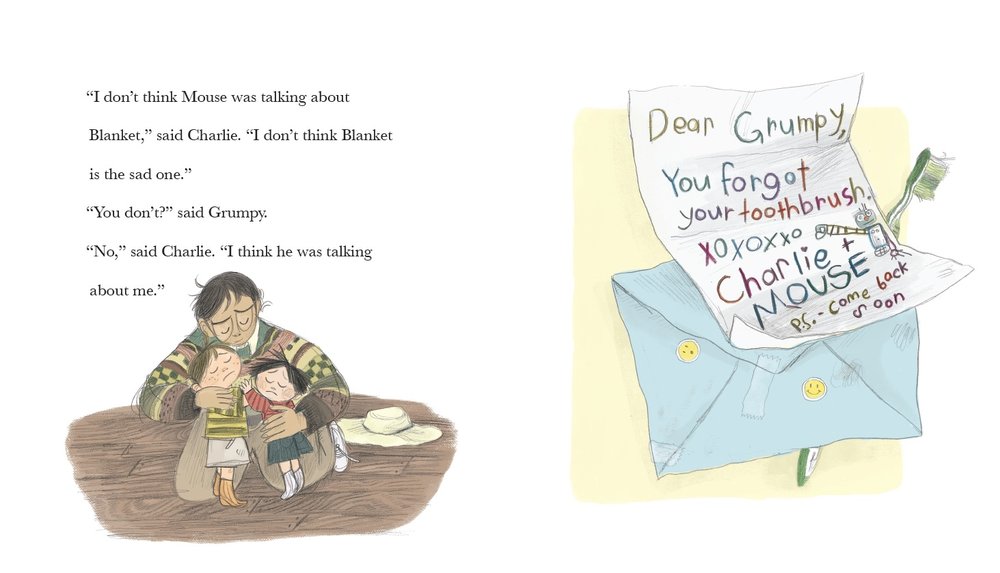
When I first encountered Snyder and Hughes’ first Charlie & Mouse title, I was delighted! Not only does the book support beginning readers in many important ways, it’s also set in Hawaii and features biracial brothers. Two things I’ve never encountered in a beginning reader title (please comment if you know of any!). For more about the first title, check out Elisa Gall’s wonderful post from earlier this year.

So imagine my joy when I found out there was to be a second book, and that it would be published in the same year! In this second title Charlie and Mouse’s bespeckled grandfather, affectionately known as Grumpy, comes to visit. Whereas the first book shared neighborhood adventures, the four episodic stories in the second book all take place inside Charlie and Mouse’s house. First, the siblings meet Grumpy at the door and talk about how Charlie is getting big; Mouse admits he’s only getting medium. The next morning, the brothers are excited to pounce on a sleeping Grumpy, but he’s already awake! Later, the boys enjoy a “Grumpy Night” while their parents go on a date, filled with pizza, forts, movies, and bedtime songs. All too soon it’s time for Grumpy to leave, but Grumpy tells the sad boys that, “Sometimes, it has to rain. So that you can be happy when the sun comes out again.”


The plot of each episode is subtly built around repetition so that readers gain confidence with the completion of each chapter. Italics are used sparingly and always to show readers something of import. For instance:
 “And how many hot dogs can you eat?”
asked Grumpy. “When you are medium?”
“You can still eat three hot dogs,” Mouse said.
“But not with mustard. Mustard is not medium.” 

Using the same soft and muted colors as the first book, Hughes’ graphite and Photoshop illustrations never overwhelm the text. Instead, they set the tone, provide visual context clues, and give insight into character relationships and emotions. No small feat!


There’s also a lot to be admired in the design and layout. The slightly wider trim side allows for truly glorious amounts of white space on all sides of the text. Line breaks are thoughtful and logical. This is especially important with so much dialogue and the quotation marks that go along with it.


All of these elements combine to create four poignant and gently humorous vignettes that draw readers like a cozy, comforting charm. When it comes down to it, both books are strong Geisel contenders and I’d be hard pressed to say which one I like more. Might this be a year when two books from the same series are recognized by the Geisel Committee?

Monday, February 19, 2018

Oh, Happy Day!: The Guessing Geisel Hosts Share Their Post-YMA Reactions

In this post, the three co-hosts of Guessing Geisel (Amanda, Amy, and Misti) share their thoughts and reactions to the 2018 Geisel Award winner and honor titles.

Watching the YMAs
Amy: Even thought I was in Denver, I opted to live stream the announcements so I could watch with my colleagues at work. We projected the live stream onto a big screen, drank coffee, noshed on breakfast-y things, and used printed ballots to predict the winners. Even thought I wasn't in the announcement room, I did my fair share of shouting and groaning. But I only had cheers for this year's Geisel results. Charlie & Mouse has held a special place in my heart all year, plus it won every mock Geisel I participated in! 
Misti: I watched the live stream from my office, as well.  Since I'm in the Collection Development & Technical Services department, I provided a source of amusement (and doughnuts) to my bemused colleagues, as the occasional "Yes!!!" or "What?!" did burst out.
Amanda: I had a reserved seat for the announcements with the rest of the Stonewall Book Award Committee. I have been unabashedly rooting for Charlie & Mouse (and I See A Cat), and was overjoyed when they were announced. I may have been embarrassingly enthusiastic in my congratulations to the committee on their excellent choices.


Charlie & Mouse by Laurel Snyder, illustrated by Emily Hughes
Amy: I cannot tell you how happy I am about Charlie & Mouse coming out on top. The timeless illustrations, the carefully considered text, and sweet humor delight me on every reread. Most importantly, as someone who identifies as biracial (Chinese-American mother, Caucasian father), I finally see myself reflected in a beginning reader (25 years late, but who's counting?).  
Amanda: Truly, Charlie & Mouse is such a special book, with such a clear sense of place and character - Laurel Snyder and Emily Hughes could not be more deserving for what they have done here and I hope that its win means we will see much more of this duo. As Amy mentioned, in addition to its objective excellence in humor, pacing, and style it also joins the ranks of beginning readers that allow readers to feel seen.  Neighbors - like Mr. Michael & Mr. Eric - broaden further the possibilities for readers to find themselves, their families, and their community reflected in this book. 
Misti: I was so thrilled to see this book win.  Apart from being super excited that our mock winner was also the actual winner (good job, you guys!), I'm a big fan of this book.  In my opinion, it has a fresh but classic feel to it, and I hope that many more beginning readers will discover this series due to its Geisel win. 

I See a Cat by Paul Meisel
Misti:  Okay, I have to admit it: this book is my favorite Geisel contender of the year. The text is so simple, but it works together with the illustrations so very well.  I'm always searching for books written at this very-beginning-reader level, and when I find one that manages to be such a delight to read . . . all I can say is, more like this, please! 
Amy: Paul Meisel certainly has a knack of engaging canine romps written for the very newest of beginning readers. The font choice in this title is particularly strong, in my opinion. 
Amanda: In addition to the simplicity and repetition that make this a strong choice for the emergent reader, as a dog owner it simply feels true to life. This title took to day at my library's Mock Geisel, and I was rooting for its simple brilliance not to be overlooked. A practically perfect book, in my opinion.

King & Kayla and the Case of the Missing Dog Treats, written by Dori Hillestad Butler and illustrated by Nancy Meyers 

Amy: I must say, I overlooked this one. Perhaps because it was one of three released in the same year? 
Amanda: This was the strongest out of the trio released this year, and is a solid choice for entry into the beginning reader puzzle/mystery lane. 
Misti: I took a second look at this one when it got some votes on our first mock ballot, and was favorably impressed.  It's definitely designed for readers who are already fairly confident, but not quite ready for big chapter books.  The mystery plot works well, there's some quiet humor, and who doesn't love a mystery-solving canine/human duo?

My Kite is Stuck! And Other Stories by Salina Yoon

Amy: By far the strongest of all the Duck, Duck, Porcupine stories, IMHO. The bright colors, bold black lines, and a silly trio make this book a stand out. 
Amanda: Charming characters and effectively bold illustrations. 
Misti: This one flew under my radar -- I was aware of it, but didn't sit up and take note, exactly.  Taking another look at it, the distinguished features Amy and Amanda mention really do stand out.  Bravo, Duck, Duck, and Porcupine!

Noodleheads See the Future, written by Tedd Arnold, Martha Hamilton and Mitch Weiss, and illustrated by Tedd Arnold 

Amy: A beginning reader with a list of sources and an author's note about the origins of Noodlehead stories! Be still my heart. I love that both the author and publisher felt that beginning readers deserve all the things found in other formats.
Misti: I can see this book being really popular with young readers -- the authors really do demonstrate respect for the beginning reader's interests and abilities.
Amanda: Tedd Arnold has a proven track record for beginning readers, and Danielle's analysis of this title really helped me to look at it in the larger context of Noodlehead stories and recognize the excellence of presenting that tradition in a way that is accessible to the new reader.

Snail & Worm Again by Tina Kügler 

Amy: Hooray for another solid beginning reader friendship duo. I adore Snail and Worm and their encouraging, supportive relationship, that is also humorous and playful.
Misti: You know what I love about this book?  Snail's eyes. They are so expressive! This is another great example of text and illustrations working extraordinarily well together.
Amanda: This was another runner-up in our library's Mock Geisel, and I need to give kudos to my colleague, our exemplary Youth Materials Selector, for advocating for its place on our shortlist. Justin, you were right.

Other Thoughts
Amy: One winner and five honors! That means libraries and schools have six easy purchases that all provide beginning readers engaging and supportive experiences. If I could add an honor, it would be Charlie & Mouse & Grumpy. I think it got overshadowed by the first C&M title, but that it has a lot of merit on it's own. If it had been published in a follow year, would it have gotten more love? We can only speculate, but I'd like to think that it would. 
Amanda: For Geisel in particular, it is always a joy to see multiple honors. You can tell in the room that even in a room full of the most passionate fans of kid lit, beginning readers don't have the exposure that picture or chapter books do, making it all the more important to recognize and hopefully raise the profile of truly excellent beginning readers. Only I See A Cat is a stand-alone title this year - caregivers of young readers have the opportunity to discover companion titles as well as these winners and expand their selection of funny, heartfelt, and otherwise distinguished books for their newest readers. Incredible work on the part of this year's committee!
Misti: I agree completely -- fantastic selections, and I'm also pleased to see so many of them.  And something for everyone, from the earliest beginner to the reader approaching full fluency. Take courage, authors, illustrators, and publishers of beginning readers: your work is important and appreciated!  I can't wait to see what the next year will bring.

Friday, July 26, 2019

One Year, One Series, Two (or more!) Books

Over the past few years, as we here at Guessing Geisel have considered which books to put on our mock ballot, I find myself pondering the same question: What happens when two+ books in the same series are published in the same contender year? 

Multiple series titles being published in the same year happens quite a lot when it comes to titles specifically created in the beginning reader format. Sometimes all the titles have the same publication date; in other cases some titles are published in the spring and others in the fall (or something along those lines). My guess (and please comment if you have further insight) is that for many kids the beginning reader window is very brief. So if a reader loves a series, they won’t necessarily want to want another year for a new title because by then they are probably further along in their reading journey. 


For the real Geisel Award Committee, this means that it’s very likely they’ll be considering at least a few titles in the same series. Although I can’t speak to any specifics from when I served on the committee, I can say that there were such titles that year. When we look at the list of past winner and honor titles a clear pattern emerges. If two or more books in one series are published in a year, only one title is selected as a winner or an honor. 


Here are some examples. Years listed are award years, so titles were published in the preceding calendar year. 

* denotes a Geisel winner 
** denotes a Geisel honor 


2019 


Fox the Tiger* and Fox is Late 


2018 

Charlie & Mouse* and Charlie & Mouse & Grumpy 

King & Kayla and the Missing Dog Treats**, King & Kayla and the Case of the Mysterious Mouse and King & Kayla and the Case of the Secret Code 


2008-2015 

2-4 Elephant and Piggie series titles published per year. In total Elephant and Piggie titles have won 2 medals and 5 honors (not counting the Elephant and Piggie Like Reading titles, as they have different authors/illustrators).


2007 

Zelda and Ivy: The Runaways* and Zelda and Ivy: One Christmas 


2006 

Henry and Mudge and the Great Grandpas* and Henry and Mudge and the Tumbling Trip 

Which makes me wonder, how would the unrecognized series title(s) have fared if they had come out a year earlier or a year later? Would Charlie & Mouse & Grumpy have walked away with a medal or honor if it wasn’t competing against the first title in the series? How about Fox is Late? Or the other King & Kayla titles published in 2017? Obviously, it’s all speculation. We can’t know what the real committees discussed, and the landscape of Geisel contenders varies from year to year. Still, I can’t help but wonder...

Friday, January 5, 2018

Let's Get Ready to Mock!

We here at Guessing Geisel are excited to announce we’ll once again be hosting a Guessing Geisel Mock Vote here on the blog.

 
There are many ways to host a Mock Award. Some take place in schools or public libraries, with young readers, or with colleagues serving as professional development opportunities. All have varying levels of similarity to the committee experience, and many adhere to the criteria to the degree that they can.

 
The actual Geisel Committee will have two full days to discuss and deliberate face to face in February, and will have spent the previous year reading, rereading, reviewing and assessing, observing beginning readers, and preparing their suggestions and nominations.

 
For most Mock Awards, participants may not have read all of the titles under consideration. If they are able to gather in person, it is often for no more than an hour or two, or their discussions may be spread out over the course of many weeks or months. If they are not able to gather in person, that component of face to face discussion is missed entirely.

 
However, we see lots of reasons to host a Mock Award. We find the more closely we can examine the criteria and mimic the balloting process, the more insight we have into the process. We come to see how only one honor book might be awarded in a given year, or how six honors might be chosen. We see how it could take multiple ballots to determine a winner, or how it might be settled after the first one. Only seven people in the entire country will actually know what happened in the room in any given year, and they will never tell. But by mimicking the experience, we develop a keener sense of how things might develop behind those closed doors.

 
Not to mention, it’s fun!

 
Sample Ballot from the Geisel Manual

Our Guessing Geisel Mock Vote will be conducted as follows:
  1. At the bottom of this post is a list of titles, to which we invite you to add your suggestions and nominations. Comment and tell us what excellent contenders are missing from our list. Or, make an argument for your favorites already included.
  2. A first ballot will be live from January 18th-24th. To mimic the voting process of the actual committee, you will have room on your ballot for three titles. A first place vote will be worth 4 points, a second place vote 3 points, and a third place vote will be worth 2 points. It's not required that you have read all books to participate, although we recommend reading as many as possible and reading reviews here and elsewhere. We are open to the possibility that we, just like the real committee, may have a clear winner after a first ballot, in which case we'll stop there and announce our results.
  3. If the first ballot does not produce a clear winner, we’ll conduct a second ballot from January 25th-February 1st. The real committee would keep going until they met the criteria for determining a winner, but we will stop after our second ballot and determine our winners. We invite you to join us for this virtual Mock Geisel with the hope that you’ll discover some new favorites for beginning readers.

 
2018 Mock Geisel Contenders