Pages

Friday, August 9, 2019

Flubby Is Not a Good Pet and Flubby Will Not Play with That, written and illustrated by J. E. Morris

Today's post comes from Jackie Partch. Jackie is a School Corps Librarian at Multnomah County Library, where she does outreach to K-12 students. She was a member of the 2012 Geisel committee.

Cover image: Flubby is Not a Good PetCover image: Flubby Will Not Play with That

Kami and her cat Flubby star in these two titles. In Flubby Is Not a Good Pet, Kami notices that all her friends' pets have special talents (i.e.: singing, jumping, playing catch), and she wonders what Flubby's special ability might be. Meanwhile, in Flubby Will Not Play with That, Flubby stubbornly refuses to play with any of the toys Kami bought at the pet store. Let's see how these books could be evaluated using some of the Geisel criteria:

Subject matter must be intriguing enough to motivate the child to read; The plot advances from one page to the next, and together with the illustrations, creates a "page-turning" dynamic

Pets (and their talents) always a popular topic for young readers, and Flubby's repeated failure to meet Kami's expectations will keep them turning the pages to see what Flubby can do (spoiler alert: he manages to please her at the end of both stories). The cat's actions and expressions add lots of visual humor, too.

New words should be added slowly enough to make learning them a positive experience;
Words should be repeated to ensure knowledge retention


Interior image from Flubby is Not a Good PetBoth books excel in this area. In Flubby Is Not a Good Pet, one new word is added as each of Kami's friends arrives, and that same word is repeated several times over the next few pages (see photo). In Flubby Will Not Play with That, words follow a pattern each time Kami tries (unsuccessfully) to get Flubby to play with a toy, always ending with, "It is fine. I have another toy."

Sentences must be simple and straightforward;

This is also a strength; most sentences are only 3-4 words long and fit on one line.

The book must also contain illustrations, which function as keys or clues to the text

Both books have a mix of full page illustrations and easy-to-follow panels. In Flubby Is Not a Good Pet, the illustrations make excellent clues; as new words are introduced, they are almost always pictured. Generally this is also the true in Flubby Will Not Play with That, but there are a few cases where text placement could work better. For example, on page 11, the text reads, "This toy rolls," but the action of rolling does not occur in the illustrations until page 12, after the reader has turned the page.

The design of the book includes attention to size of typeface, an uncluttered background that sets off the text, appropriate line length, and placement of illustrations

The typeface is large, in a sans serif font, and is easy to read. Words are sometimes smaller in speech bubbles and sound effects, although those are not necessary to read to understand the plot. Text is sometimes placed over the illustrations, but always in an uncluttered area.

The book shows excellent, engaging and distinctive use of both language and illustration

I always find this criteria a difficult one to judge until I'm comparing books. I enjoyed both of these books, and I think beginning readers will, too. Will the committee decide that they are "excellent, engaging and distinctive?" Leave a comment with your ideas.

Wednesday, August 7, 2019

Garden Day! by Candice Ransom, Illustrated by Erika Meza

Garden Day! by Candice Ransom,
illustrated by Erika Meza book cover
It’s spring! The perfect time for planting seeds and pulling weeds. A boy and a girl joyfully help their male grown up in the garden. Seeds are planted. Scarecrows made. Finally, the whole family, including mom, makes a visit to the local farm stand. 

You might recognize this family. They’ve been featured in other seasonally relevant Step into Reading titles by Ransom and Meza, including Snow Day!, Apple Picking Day!, Garden Day!, and Pumpkin Day! As with other titles in this series, the large font and ample white space are excellent. 

Let’s take a look at the words. Most words are single syllable, with just a few double syllable words thrown in (scarecrow, hungry, buzzing). There’s also the rhyming text to consider. Rhyming may help some readers predict the final word in a sentence, however the lack of word repetition may hinder readers by introducing too many new words without adequate support. 


Image from Garden Day! by Candice Ransom,
illustrated by Erika Meza
The rhyme scheme also causes some hiccups with sentence structure. Often times this means sacrificing full sentences in favor of sentence fragments that rhyme. Additionally, the use of em dashes could be confusing to some readers who may not be familiar with this punctuation mark. For instance this spread reads, “Water garden-- / and you too!” 


Image from Garden Day! by Candice Ransom, 
illustrated by Erika Meza

The through-line of the story -- planting and tending a garden -- holds up well until the penultimate page turn. Suddenly, the family is at a farm stand. Without any foreshadowing or relevance to the plot line, this abrupt change in location is quite jarring. 


Image from Garden Day! by Candice Ransom, 
illustrated by Erika Meza
All in all, this title, and indeed the whole series, is commendable for featuring all brown-skinned, dark-haired characters, however there’s less to praise when evaluating the elements necessary to support new readers. While I’m happy to have this book on my shelf to recommend, I would be surprised if this title is given any Geisel Award love this year.

Monday, August 5, 2019

We Are (Not) Friends by Anna Kang, Illustrated by Christopher Weyant

Photo courtesy of
Robbin Friedman
Robbin Friedman is a children's librarian at the Chappaqua Library. She writes reviews for School Library Journal, serves on ALSC's Budget Committee, and reads a lot of science fiction.

We Are (Not) Friends by Anna Kang,
illustrated by Christopher Weyant book cover


Geisel Award-winning team Anna Kang and Christopher Weyant return with another fuzzy monster book, the third companion to You Are (Not) Small. After the crystalline simplicity of the winning first title, We Are (Not) Friends broaches slightly more complicated territory, in both emotional and literary content.


The early reading foundations of Kang and Weyant’s work remain the same. The story unfolds as dialogue between three characters, mostly printed in a large, well-spaced serif typeface. Jaunty lines connect the speaker to each instance of dialogue; sound effects and a few shouts appear in a legible, handwritten typeface. Variations in font size, occasional italics, and underlined words guide the reader’s emotional expression, while remaining comprehensible.

Image from We Are (Not) Friends by Anna Kang,
illustrated by Christopher Weyant

Still, We Are (Not) Friends introduces a layer of difficulty beyond the earlier text. The story examines the challenges--emotional and logistical--that come from bringing new friends into an existing relationship. Over the course of the narrative, alliances shift and the two original friends each experience feeling slighted and jealous before settling into a happy trio. This story of friendship, kindness, and hurt feelings will resonate with most beginning readers, who may also be beginners at cultivating relationships and reacting to other people’s emotions. But the dynamics reverse quickly, and readers new to decoding text will also have to decode the illustrations to understand when the three creatures feel excluded, or sad, or excited. The open faces and expressive body language, set against uncluttered backgrounds, offer readers ample clues to the characters’ emotions, but readers will still need to know what to do with that information.

Image from We Are (Not) Friends by Anna Kang, 
illustrated by Christopher Weyant
As with the earlier texts, Kang keeps the sentences short, employing sight words and repetition. But not every vocabulary word gets enough support and in one case, it may affect the reader’s experience. Early on in the book, newcomer Blue hands Yellow a cane (a la Fred Astaire) and suggests “We can do a duet.” This two-person activity, proposed while all three characters are together, sets the stage for the jealousy and exclusion that come next. But will beginning readers recognize the word “duet” (or know how to pronounce it)? Will they identify that it separates two characters from the third? The illustrations pull a lot of weight on the following spread, depicting Purple’s growing discontent at being left out. But the book never returns to the crucial piece of vocabulary, so readers likely won’t have understood the new term in context, or learn it for the future. Other terms--two-seater, dinosaur, attack--fall well outside any standard sight-word list.

As a relatable saga, We Are (Not) Friends pairs tension and humor, a great combination to induce Geisel-criteria page-turning to the very end. And the final turn (familiar to readers of Chester’s Way, among others) will satisfy most readers. People looking for age-appropriate tales of navigating friendship will find this book charming, funny, and emotionally astute. But the Geisel Committee, looking for scaffolding and success, probably won’t call for an encore.  

Friday, August 2, 2019

The Book Hog by Greg Pizzoli


The Book Hog loves books, but he can't actually read them. He just likes collecting them. One day, he wanders into a library and is invited to join a storytime program. With time and some help from the librarian, he eventually learns to read, so he can appreciate his books for the stories they contain.

This picture books has several elements that will be useful to the beginning reader, but also some challenging areas. It has a nice, large font, which always appears on a solid background. There are some instances of hand-lettered text appearing in the illustrations, but it's never integral to the story. Many of the sentences are only a few words long (though some, particularly in the middle of the book, are more complex, with one reaching 22 words in length), and sentence breaks are never carried over a page turn (though a couple of new sentences do begin with "and" or "but"). Some of the vocabulary in the book may be challenging for new readers, particularly words like "especially," "surrounded," "several," and "swallowed."


As I librarian, I found myself saying, "That's not actually how storytime works," when the librarian offers to read the Book Hog as many books as he would like, of his own choosing. It's a lovely thought, to be sure. However, that opinion doesn't necessarily bear on the Geisel criteria. The points I've raised about vocabulary and sentence length are more likely to be of concern to the committee. I wouldn't necessarily count this book out in terms of Geisel recognition, but it will need to be examined in light of other books in the field this year to determine whether it rises to the top.

Monday, July 29, 2019

Mr. Monkey Takes a Hike by Jeff Mack


Mr. Monkey Takes a Hike by Jeff Mack book cover
Jeff Mack’s Mr. Monkey is back for another adventure! This time the great outdoors beckons, or rather, it coerces him into a rather reluctant trek to recover his stolen video game controller.

Mr. Monkey just wants to win his video game. Over and over again he runs, ducks, climbs, swings, jumps, and then falls. He just can’t win! In a fit of anger, Mr. Monkey puts down his game controller and shakes his fists at the TV screen. But wait, what’s this? When a little bird swoops in and snaps up Mr. Monkey’s controller, everyone is in for an adventure! Mr. Monkey chases the bird through town and into the woods, mimicking his video game as he runs, ducks, climbs, swings, jumps, and, inevitably, falls, shaking his fist at his feathered foe. Yet even in the midst of his frustration, Mr. Monkey takes a moment to appreciate the natural world before sprinting off after the bird once more.

Image of Mr. Monkey playing a video game from Mr. Monkey Takes a Hike by Jeff Mack
The comic format functions as an effective introduction to a panel layout, and font choices help differentiate primary text from dialog. The main text is displayed in serif font, while the characters express their emotions through sans serif font within word bubbles. The book even introduces comic-style sound effects with the occasional “SMACK” and “BOING!”.

The repetition of the text works on multiple levels. First and foremost, the simple sentences and oft-repeated chunks of text provide emerging readers ample opportunity to build confidence. Yet the repetition also echoes Mr. Monkey’s persistence; he may shake his fist in anger when he falls, but he gets up and tries again. And again. And again. The situation and scenery vary enough that the repeated text never approaches tediousness. 

Image of Mr. Monkey sleeping from
Mr. Monkey Takes a Hike by Jeff Mack
This books is a strong contender for kid appeal. The humor of Mr. Monkey’s outdoor adventure strikes just the right chord of slapstick paired with subtle wit. Mr. Monkey chases a bird, goes over a waterfall, smacks into a moose’s backside, and bounces from a trampoline to a storefront awning to make it home—what’s not to like?!

The text also lends itself well to multiple readings. As readers grow more confident with the text, they will find plenty to pore over within the images, including a fender bender between a cyclist and a carrot car, a turtle carrying a hamburger on its back, and a cow driving on the wrong side of the road.

Many readers will be able to connect with Mr. Monkey’s obvious and mounting frustration as his attempts fail—first he cannot win his video game, then he cannot get his controller back, and finally it seems doubtful he will even get home in one piece. GRR! But he tries and tries again, and his persistence pays off. He recovers the controller and arrives home, albeit a little worse for the wear and far too tired to make another attempt at winning his video game. Perhaps he’ll be ready to try again tomorrow, after an extra-large dose of fresh air and an extended tech break; as long as he can find his controller...

Friday, July 26, 2019

One Year, One Series, Two (or more!) Books

Over the past few years, as we here at Guessing Geisel have considered which books to put on our mock ballot, I find myself pondering the same question: What happens when two+ books in the same series are published in the same contender year? 

Multiple series titles being published in the same year happens quite a lot when it comes to titles specifically created in the beginning reader format. Sometimes all the titles have the same publication date; in other cases some titles are published in the spring and others in the fall (or something along those lines). My guess (and please comment if you have further insight) is that for many kids the beginning reader window is very brief. So if a reader loves a series, they won’t necessarily want to want another year for a new title because by then they are probably further along in their reading journey. 


For the real Geisel Award Committee, this means that it’s very likely they’ll be considering at least a few titles in the same series. Although I can’t speak to any specifics from when I served on the committee, I can say that there were such titles that year. When we look at the list of past winner and honor titles a clear pattern emerges. If two or more books in one series are published in a year, only one title is selected as a winner or an honor. 


Here are some examples. Years listed are award years, so titles were published in the preceding calendar year. 

* denotes a Geisel winner 
** denotes a Geisel honor 


2019 


Fox the Tiger* and Fox is Late 


2018 

Charlie & Mouse* and Charlie & Mouse & Grumpy 

King & Kayla and the Missing Dog Treats**, King & Kayla and the Case of the Mysterious Mouse and King & Kayla and the Case of the Secret Code 


2008-2015 

2-4 Elephant and Piggie series titles published per year. In total Elephant and Piggie titles have won 2 medals and 5 honors (not counting the Elephant and Piggie Like Reading titles, as they have different authors/illustrators).


2007 

Zelda and Ivy: The Runaways* and Zelda and Ivy: One Christmas 


2006 

Henry and Mudge and the Great Grandpas* and Henry and Mudge and the Tumbling Trip 

Which makes me wonder, how would the unrecognized series title(s) have fared if they had come out a year earlier or a year later? Would Charlie & Mouse & Grumpy have walked away with a medal or honor if it wasn’t competing against the first title in the series? How about Fox is Late? Or the other King & Kayla titles published in 2017? Obviously, it’s all speculation. We can’t know what the real committees discussed, and the landscape of Geisel contenders varies from year to year. Still, I can’t help but wonder...

Monday, July 22, 2019

Introducing Our New Co-Host - Kahla Gubanich

Image: Headshot of Kahla Gubanich
Courtesy of Kahla Gubanich
Today I'm excited to bring you an interview with our newest co-host, Kahla Gubanich. While Amanda is taking time off from blogging to focus on the birth of her own beginning reader, we're happy to have Kahla's wit and editor's eye to help us out. Kahla and I worked together for several years (we coordinated mock award discussions together, among other things), and I'm thrilled to have the chance to do so again, even if we're still thousands of miles apart. Without further ado, let's get to know Kahla!

What's your current position and what's your favorite part of the job? 
As it happens, I'm transitioning! I currently manage my library's makerspace in Carroll County, Maryland. The makerspace is designed to help kids of all ages develop STEAM skills through hands-on experiences. My favorite part of the work is seeing young customers learning entirely new skills; and they often reach a point where they can turn around and explain or teach those skills to someone else. It's so rewarding to watch someone go from feeling intimidated and overwhelmed by something to feeling confident and proud of their hard work and persistence. Very soon, though, I'll be moving to a position as Children's Services Supervisor in neighboring Frederick County, and I'm so excited to face the new challenges that will come with the change! 

What are you most excited about as a new co-host for Guessing Geisel? 
I'm really looking forward to engaging in the conversation around beginning readers with all of the blog's contributors and readers! The old stereotype is that librarians enter the field because we love to read; but I think it's more accurate to say we love to talk about books. And what better place is there to talk about beginning readers than Guessing Geisel?! 

How many years have you been guest blogging for Guessing Geisel? 
This will be my fourth year (check out Kahla's past posts), and I'm super excited for another season of high-quality books and thoughtful reviews from my colleagues around the country. 

What do you love about the Geisel Award? 
I love that the Geisel is open to so many different formats and genres; the award really embraces the idea that a child can learn to read (and learn to love to read) with any book! That said, I'm crossing my fingers for some more nonfiction titles to work their way into the winner and honor slots in the coming years... 


What's your beginning reader pet peeve? 
I tend to get annoyed by sentences that span a page turn. Especially for readers who are truly just learning, it can be challenging to hold the thread of a sentence across multiple pages. It also makes it more difficult for readers to sound out the full sentence and then repeat it again for comprehension. 

What's your all time favorite beginning reader or Geisel winner/honor? 
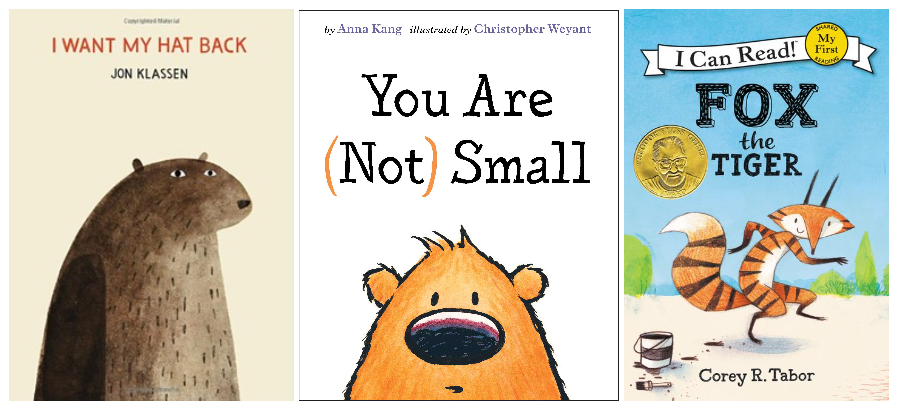
I Want My Hat Back (2012) gets me every time; I always love a bit of woodland drama and resulting carnivorous behavior. But I also have a soft spot in my heart for You Are (Not) Small (2015) for its almost magical ability to convey so much childhood truth with so few words. And the final page always makes me chuckle. But then again, the humor and imaginative play in Fox the Tiger (2019) is completely delightful. Oh, I'm sorry, you asked for just one favorite...?! 
Image: Book covers side by side
I Want My Hat Back by Jon Klassen, 
You Are (Not) Small by Anna Kang, illustrated by Christopher Weyant, 
Fox the Tiger by Corey R. Tabor
When you're not librarian-ing, what do you like to do? 
Old hobbies include knitting, drawing, hiking, camping, and frequently losing my mind over the general cuteness and hilarity of ducks. Newer hobbies include hammocking, archery, and occasionally pretending to be a tiger.