Pages

Wednesday, October 10, 2018

Fergus and Zeke at the Science Fair by Kate Messner, illustrated by Heather Ross

Fergus and Zeke at
the Science Fair book cover
The classroom mice duo from last year's Fergus and Zeke are back for a second round of adventures. This time the kids in the mice's classroom are getting ready for the science fair and Fergus and Zeke want to participate too. But each project the mice try to copy goes humorously wrong. Finally, the pair decide their experiment will be to train the kid using them as an experiment!

Ross's digital illustrations are bright and cheery. Targeting the upper range of the award criteria, the longer chapters (approximately 10 pages each) are broken up with a combination of spot and full-bleed illustrations. As is suitable for this reading level the illustrations provide some context for new words and concepts, especially how each experiment works, but there are fairly large text blocks as well. 

Messner builds repetition into the text quite often. For instance, the word "experiment" is used 5 times in the first chapter alone. There are a few multi syllablic words used only once, which could trip up some readers; words like "announcement" and "masterpieces." But for the most part new words are repeated to allow for lots of practice.
Image of mice listening to a teacher read and doing classwork from Fergus and Zeke at the Science Fair.
This is a school-oriented story with a rather obviously educational bent to it. In fact, nit would have been nice to have back matter with step by step instructions for each of the experiments mentioned in the text. It certainly has plenty of supportive features, but I wonder if it will provide enough page turning appeal for readers. What do you think?
Image of a school science fair from Fergus and Zeke at the Science Fair.

Tuesday, October 9, 2018

Maud the Koala series by J.E. Morris

Cover of Much Too Much Birthday by J.E. Morris
 Cover of Fish Are Not Afraid of Doctors by J.E. MorrisThe new Maud the Koala series by J. E. Morris makes broad use of the sort of graphic novel style panels we’ve seen used so effectively in other beginning readers, with colorful illustrations in a woodcut style. Where the series really excels is in portraying Maud’s experiences in a way that makes her anxieties relatable and accessible to the target audience.

In Much Too Much Birthday, effective use is made of both text and illustration to depict how Maud’s “You can never have too much birthday” attitude is changed as she is squeezed, squashed, jostled, and jabbed. Maud’s pursuit of a little quiet seems entirely natural. There is excellence in the use of the illustrations to contrast the hectic party scene with the calm of the hiding place behind the bushes. Washing out the party scene to allow the reader to focus on the characters referenced in the text is supportive of young readers relying on picture clues to support their decoding. The ending empowers Maud to find her own solutions, both for herself and her friend Simon, which is very respectful of a child reader. 
Interior from Much Too Much Birthday where Maud Koala looks overwhelmed, depicted by a spiral behind her clutching her head. And inset shows her hiding behind a bush.
In Fish Are Not Afraid of Doctors, Maud is nervous about her checkup and getting a shot. By pretending to be a fish, she gets through the experience just fine and gets a sticker as a reward. There is plenty of repetition of vocabulary like “vaccinations” and “pretended” throughout, and the illustrations are vibrant and engaging. The use of panels keeps the story moving for a reader. Vaccination is at one point phonetically misspelled as “vax-i-nay-shun”, which may help a more confident reader with a potentially unfamiliar word.
An adult directed Note to Caregivers at the end of each book in the series calls out the techniques depicted in the story which may help children cope with an overwhelming situation, yet for the most part the series avoids feeling like didacticism has outweighed considerations of quality. 

5 panels depicting Maud hiding in the doctor's cabinet to avoid getting a shot, then being discovered by her mother and returning to the table for an explanation of what vaccinations are.

Librarians often hear from parents looking for an updated picture book to prepare their child for experiences like visiting the doctor or dentist. Maud the Koala fills this need, and I wouldn’t hesitate to include it in my recommendations to parents. However, it’s this strength that makes me question whether Maud the Koala is really intended for independent reading. Despite its beginning reader trim size, the font and leading are not as large or spacious as we would expect from text directed at beginning readers. Because of the effective use of panels, there’s quite a bit of text on most two-page spreads, and some lengthier sentences. Overall, intended audience would appear to be a child and caregiver together, right down to the caregiver note at the end of each books. Of the two, I think Much Too Much Birthday is more qualified as a Geisel Contender, but I think the true strengths of Maud the Koala may be best appreciated during shared rather than independent reading. What do you think?

Friday, October 5, 2018

Flower Wings: Marigold Fairy Makes a Friend by Elizabeth Dennis, illustrated by Natalie Smillie

Photo courtesy
of Lizzie Nolan
Lizzie Nolan is a Senior Librarian in Youth Services at the San José Public Library. Under the great inspiration of this very blog she helped start a mock Odyssey award blog for great childrens’ audiobooks at Ears on the Odyssey.

In an enchanted garden, Flower Wings are fairies with magical powers from the blossoming flowers. Marigold Fairy is best buds with Butterfly, and they do all things best friends do together in the garden: eat, cook, and tend to the vegetables. But oh they spot a pest! Can a pest be a friend too?

Marigold Fairy Makes A Friend is the second in the Flower Wing series from the Simon & Schuster imprint Simon Spotlight’s Ready to Read collection. As Editorial Director Siobhan Ciminera notes in this Guessing Geisel interview, the Ready to Read books follow to a set of well developed design principles that focus on helping make a positive reading experience for new readers. The adherence to these guidelines certainly mirror some of the Gesiel award criteria.

Book cover of
Flower Wings: Marigold Makes a Friend
by Elizabeth Dennis, illus. by Natalie Smillie
First off, Natalie Smillie’s illustrations create a bubbly and gentle world of fairy dust and blooming flowers that certainly have child appeal. Smillie’s rounded drawing style invokes an inviting softness. The garden world too is incorporated in simple ways: Marigold’s Fairy’s dress is an inverted marigold and dinner table lights are flower petals. And all the fairies are encased in just a wee bit of sparkle dust.

True to the stated “Level One” standards, this book has “easy sight words and words to sound out”, “simple plot and dialogue” and “familiar topics and themes.” For the most part, the illustrations match the plot and the word choice is limited and very focused. The plot is very simple, but still child relatable. Marigold and Butterfly want to do the right thing but how can they take care of the garden and include the pests as friends?

The final page of this read contains a bit of educational back matter titled: “The Science behind the Story” that explains that marigold and butterflies have a real symbiotic relationship in the nature world. While informative, the design uses a small font without much white space, which might be lost on readers at this level. A two page spread might have worked better.

Moreover, this book could work well for those readers who are attracted to but not ready for the Rainbow Magic Fairy world. Featuring a main character of color, Marigold Fairy is also an example of everyday diversity.

Though not top of my list for Geisel award 2019, Marigold Fairy Makes A Friend is affable and glittery, and could find a reader with someone looking for a little magic.

Wednesday, October 3, 2018

Peter & Ernesto: A Tale of Two Sloths by Graham Annable

Today's guest contributor, Anna Taylor, is the Assistant Head of Children’s Services and Collection Development Coordinator for Darien Library in CT. She's a co-convener of ALSC's Children's Collection Management Discussion Group and serves on YALSA’s Quick Picks for Reluctant Young Adult Readers. Find her on Instagram @librarianna 

Cover of Peter & Ernesto A Tale of Two Sloths depicting both sloths peeking out of a tree - one right side up, one upside down.
Images provided by Anna Taylor
The first book in a new series, Peter & Ernesto join the early reader/graphic novel bandwagon incorporating repeating words, bold text, and simple plots in a graphic novel format.

In this first installment, the reader is introduced to Peter and Ernesto, two sloths who are content sitting in their tree and seeing cloud shapes in in the sky. When Ernesto is convinced he must see all of the sky instead of just their small piece while in the tree, he leaves Peter to go on an adventure thus beginning the plot of the story.

This book is told entirely via speech bubbles from the characters. The speech bubbles have a bold black line outlining the white bubble making it easy to find for young readers. The speech bubbles will change their shape based on certain actions. For example, when Ernesto is walking across a wobbly bridge and steps off, he still feels “wobbly” and the speech bubble is a curvy circle to show what the word “wobbly” means and feels like.


The characters Peter and Ernesto have an Elephant and Piggie feel that kids will recognize as they go back in forth in simple dialogue and friendship ends up being the central focus of the story. One thing that makes Peter and Ernesto stand out from the Willems crew is the format and trim size of the physical book. The book is told via comic panels throughout, has a larger trim size, and a page count of 128 pages.

Peter and Ernesto is a great introduction to graphic novels for young readers and those who are already comfortable with beginning reader books. While the plot is simple, the long page count and use of large words such as “Hibiscus” and “admirable” increase the level of the book. However, readers straddling the line of Toon Books and Dog Man will be thrilled to read about two sloths named Peter and Ernesto.

I believe that Peter & Ernesto: A Tale of Two Sloths is a strong contender for the Geisel Award and is anything else, a new favorite series for young readers.

Monday, October 1, 2018

How To Get Picture Books With Beginning Reader Features Into the Hands of Independent Readers

For the most part, picture books and beginning reader books have different, though equally important, functions. Picture book reading is generally a shared experience, often between a pre-reading child and an adult – though, of course, picture books can be enjoyed at any age! As such, picture books often have rich, complex vocabulary and syntax, intricate plot structure, and vibrant, eye-catching illustrations that invite the listener to contemplate the details. Often, the illustrations tell the story, or embody sly jokes or secondary plot lines.


Cover image: Not A Box by Antionette Portis
Beginning reader books are for readers who are working towards competence and independence. Though they may often have an adult at their side, it is the child who is reading, and the book is designed to further that purpose. The writing is straightforward, often featuring repetition, especially of new vocabulary. Illustrations are still essential, but they generally reinforce the story, offering important visual clues to help decode the text. And, whereas picture books can play around with font size and placement, in beginning reader books the font tends to be large, plain, and placed on a solid background for ease of reading. Every now and then, however, a picture book arrives on the scene that does double duty: while still serving as an excellent read-aloud, the book also contains some of the features that make it valuable to beginning readers. (These rare unicorns are often excellent storytime choices for large groups as well.) Each Geisel committee is on the lookout for them, you may be sure! And find them, they do: consider Not a Box, First the Egg, I Want My Hat Back, The Watermelon Seed, and many others. And, of course, many great books of this sort are published every year to no accolades whatsoever, but may still be beloved of, and useful to, children who are learning to read.


Cover Image: First the Egg by Laura Vaccaro SeegerThe question is, how do we get these excellent picture books into the hands of beginning readers? In a typical library picture book collection, these books slip into alphabetical anonymity, filling their places among the ranks of traditional picture books, never to be spotted by those readers who need them (for, though your library may have a robust beginning reader collection, one thing I know about children learning to read is that they always need more books).

I’m afraid all of my solutions are basic ones, probably ones that you have already considered and/or implemented. But just in case…

Shelving: Possibly the most effective answer is to shelve picture books that function as beginning readers with the beginning readers. If your budget is generous, you could even double-purchase these titles, so that they exist in both collections. In most libraries, this is not an option – there’s no budget for duplicate copies, and there may not be space in the beginning reader section for extra titles. Often, the shelves in that section will be configured to hold beginning reader titles of a standard size, which precludes the addition of larger picture books (or even beginning reader books in a larger-than-usual format). Another shelving solution would be to pull out these titles into a special area of their own, possibly at the beginning or end of the picture book section. Though I know of some libraries with special collections of picture books (concept books, for instance, or picture books for older readers), I’ve never come across a library with a special area for picture book beginning readers. If your library has one, I’d love to hear about it!


Cover image: I Want My Hat Back by Jon Klassen
Labeling: As librarians, we love our spine labels (or, at least, some of us do!). If you can’t separate out your picture books for beginning readers, you might consider adding something to your spine labels to designate that these books work well for beginning readers – perhaps just a colored dot or label cover. Of course, you’ll need signage to guide people to those books (and that only works for the ones who can and do read the signs).

Displays: If you can’t make collection-wide changes to how your books are shelved or labeled, perhaps a good display every now and then can help. A mixed display of beginning readers and picture books can be a real winner, especially at the beginning of the school year. If you have display space near your beginning reader books, that’s an ideal spot.

Book lists: Does your library have a rack of book lists for patrons to pick up? A binder full of them behind the desk for staff use? Online lists on your website with links to your catalog? Why not make a list of great picture books for beginning readers to add to those resources? Check out this great example of an online list from the Sacramento Public Library.


Cover image: The Watermelon Seed by Greg PizzoliStaff training: This piece actually goes with all of the others – but it can stand alone, as well! If you’re at a library where other staff members may be looking at new picture books, creating displays, compiling book lists, and assisting customers, make sure that they’re aware that there are great books for beginning readers in the picture books, as well as in the beginning reader section. If you’ve adopted new shelving or labeling strategies, make sure that anyone who has a say in the placement of new books knows how to evaluate picture books for elements that make for good beginning readers, and that everyone is confident about helping readers to find their just-right books. And be sure that anyone who contributes to your book lists, whether on paper or online, is keeping an eye out for new titles to keep your list fresh.

Though I’ve offered a few basic ways to promote picture books for beginning readers, I’d be very interested to hear what your library does to address the issue. Have a creative solution I haven’t thought of? Post in the comments below!

Friday, September 28, 2018

Noodleheads Find Something Fishy by Tedd Arnold, Martha Hamilton, and Mitch Weiss, illustrated by Tedd Arnold

Danielle Jones is a youth and teen librarian in Portland, Oregon. She has served on the 2018 Sibert Committee and the 2016 ALSC Notable Children’s Books Committee.

Book cover of Noodleheads Find Something Fishy
by Tedd Arnold, Martha Hamilton, and Mitche Weiss,
 illus. by Tedd Arnold
The team that brought us last year’s 2018 Geisel Honor Noodleheads See the Future have joined up again to bring us a third book in their Noodleheads series. Paying homage to folklore’s noodlehead stories, this Holiday House publication written by Tedd Arnold, Martha Hamilton, and Mitch Weiss, and illustrated by Tedd Arnold, delivers the same great humor and storytelling as its predecessors.

In this early reader graphic novel Mom Noodlehead wants to get the Noodlehead brothers, Mac and Mac, out of the house. Giving them a snack and a coin each, she sends them out to the great outdoors in hopes that they will learn something new. Mac and Mac, having found a fishing pole, decide to learn how to catch a fish. Similar to this year’s Vernon is on his Way: Small Stories by Philip C. Stead, fishing in this book also can look very different from what is expected, adding to the humor of the book.

In putting this up to the Geisel criteria, this hits a lot of marks. It has a great story arc that is carried over a series of short, episodic chapters. Both the storytelling and graphic novel paneling offer great pacing and page turns. Bold color illustrations are offset by large speech bubbles, that offer plenty of necessary whitespace for emerging readers. Certain words are in bold to add extra dramatic emphasis that readers will easily pick up on.

I felt that this year’s Noodleheads was making more of a conscientious effort around controlled vocabulary and its use. New words like “rental” and “promise” were repeated, and often on the same double page spread. I also felt that the jokes in this book were more layered, respecting that the reader had enough sophistication to catch the irony.
6 panels showing the Noodleheads buying worms from Miss Froggy's Bait Shop
Though this wouldn’t necessarily be a consideration for the Geisel committee, as an adult reader sharing stories with children, I appreciated the authors’ note where they break down the etymology of each Noodlehead story element and its cultural background. What seems like effortless storytelling actually stems from a rigorous of study of noodlehead and noodlehead-type stories from all over the world.

One concern I have is the portrayal of Mom Noodlehead in her 1950’s-esque dress and house apron. It felt very gendered and antiquated in a story that I felt was set in a more contemporary world.

For the most part, this is a strong contender for the Geisel committee, and though we won’t know for sure, I wouldn’t be surprised for it to at least make to the table for discussion in Seattle come January.

Wednesday, September 26, 2018

Take a hike, Miles and Spike! by Travis Foster and Ethan Long


Photo of Sylvie Shaffer in front of library shelves
Photo provided by Sylvie Shaffer
Today's contributor, Sylvie Shaffer, served on the 2018 Geisel Committee. She’s the preK-8 librarian at the Capitol Hill Day School in Washington, DC and is active in several overlapping kidlit-focused communities including ALSC and Capitol Choices. She is currently serving on the Sydney Taylor Book Award and is busy parenting her own five year old emerging reader with help from her wife in Takoma Park, Maryland where she also serves on the Board of the Friends of her local library.  


Cover art from Chroniclebooks.com

Miles and Spike set off on the titular hike on the book’s title page, and continue pillaging resources from and dismissively bidding animals farewell as they stuff their increasingly full pack until they can no longer carry it. The pair’s realization that they can’t lift their pack, along with the animals’ collective response, forces them to realize- and remedy- their wrongdoings.


Much of the story is told through Travis Foster’s deceptively simple illustrations, which feature monochromatic backgrounds that highlight each scene’s full-color interaction between Miles, Spike, and whichever animals they are currently insulting. Each illustration also shows in muted tones matched to the background colors, the ever-growing mob of seething critters the pair has angered along the way. This artistic choice helps beginning readers track the story’s arc and serves well both as a running visual gag and as a reminder of the text’s rhythm and rhyme pattern.

An angry gazelle, buffalo, and dragonfly look on as Miles and Spike pack a bag for hiking.
Photos by Sylvie Shaffer


A number of details around word choice elevate this picture book to Geisel contender. The repeating pattern of “See you later, Alligator” type phrases is established from the first pages and maintained throughout the text, save for a few pages - one with a nonsense sound that’s fun for readers, and the other featuring two simple words, “pant” and “drip”  repeated five times each. Each of these two pages gives readers who’ve been working hard in the preceding pages a chance to rest and feel successful. Note, though, that even the few trickier, longer creature names (Dragonfly, Gazelle) are easily decodable. And perfectly upholding the Geisel criteria, if the book’s emerging reader is still stuck, the cartoony illustrations offer clues. Perhaps the most useful feature of the book as a reading primer is that rhymes utilize the same letter combinations only half the time, reinforcing to early readers that there are multiple ways of spelling the same sound. (dumb/chum; again/then; here/deer)
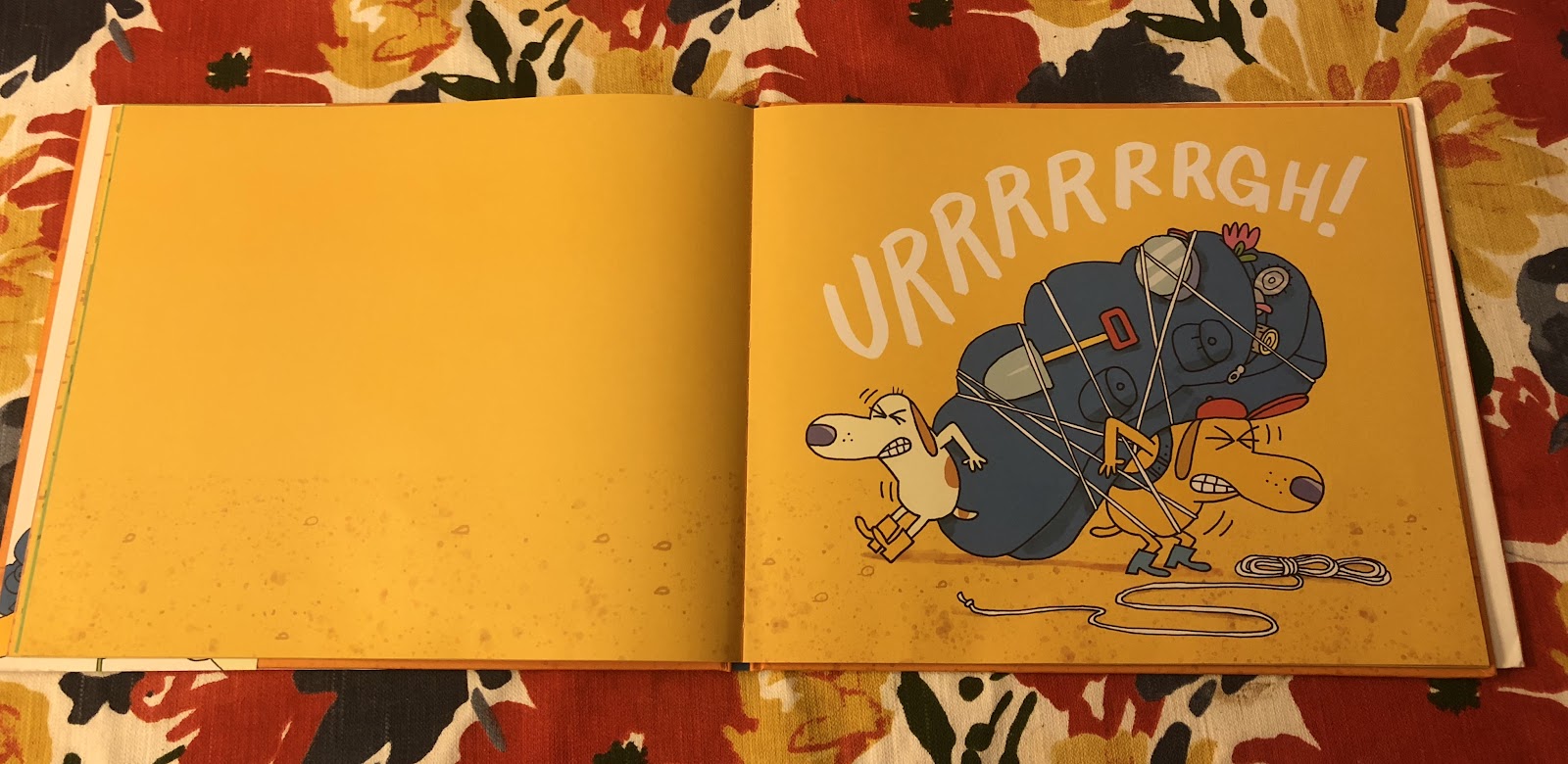
Miles and Spike struggle with an "Urrrgh" to life an overstuffed pack.
Canine pals Miles and Spike’s characters are well-developed in the first half of the story through their careless and dismissive words and actions towards the other animals in the forest. When the pair realize the errors of their ways, they undergo a true and believable change of heart and try again, mending relationships with the animals they’d hurt, and sharing messages with the book’s beholders about the importance of owning one’s mistakes, “We acted dumb, chum.”, the power of inclusivity, “Join the fun, EVERYONE!”, and trying again when you get something wrong the first time.
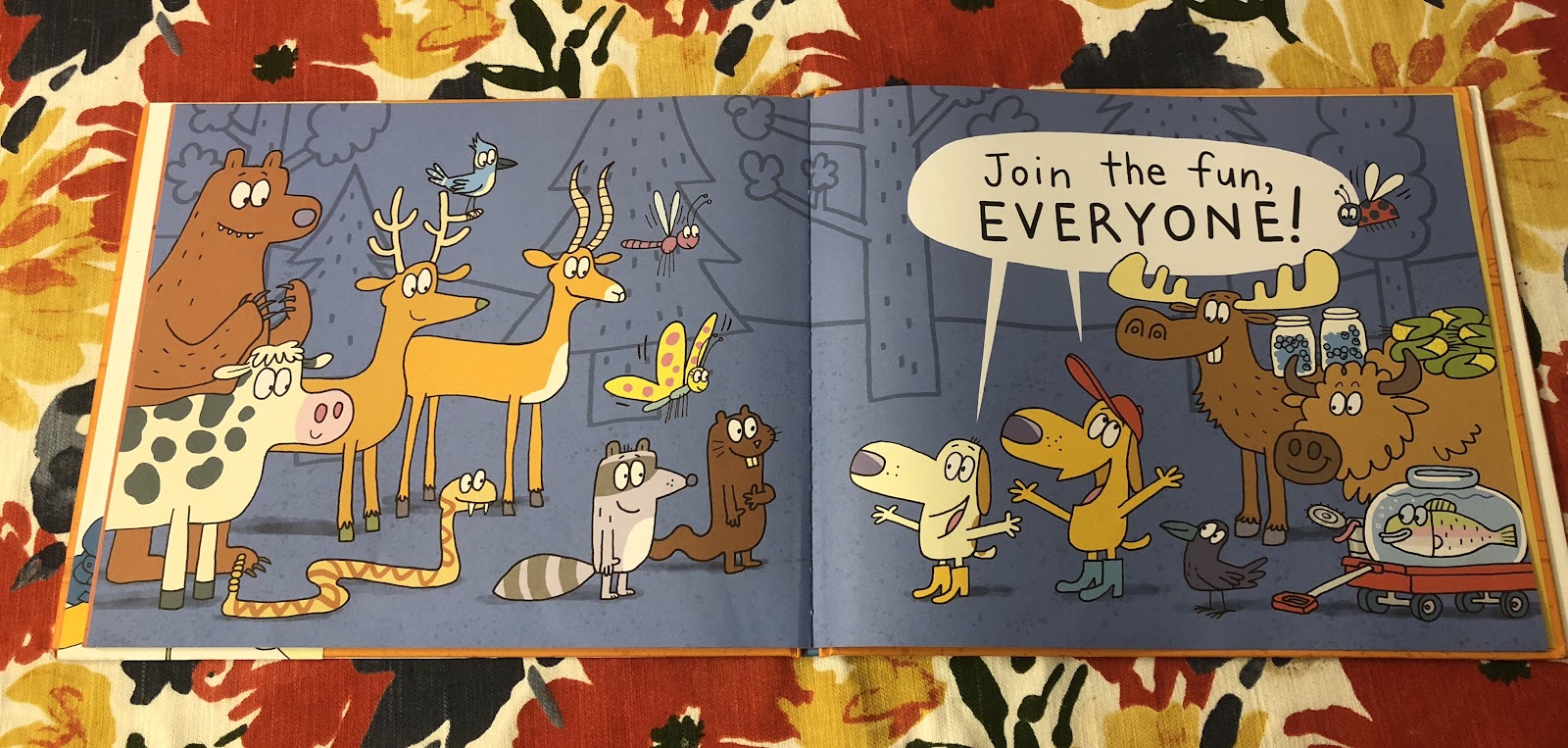

Other animals look on smiling as Miles and Spike invite them to "Join the fun, everyone!"
While the book’s messages are both valuable and conveyed in a not-too-overly-didactic way, they hold no bearing on its Geisel eligibility...except maybe that last one, about trying again...thematically, I see echos of Laurie Keller’s 2017 Geisel winner, “We Are Growing.” Specifically, the idea that personal growth is a journey of stopping, starting, and trying again is one that closely mirrors the process of learning to read, of sounding words out, maybe getting them wrong along the way. In addition to this message of resilience, Take a Hike, shares many markers and conventions - regarding both text and illustration- apparent in many prior Geisel winners and honors: a tight word count (under a hundred!) highly effective use of dialogue bubbles, repetition of patterns including rhyme, shifting a lot of the heavy lifting of storytelling to the illustrations, humor, and anthropomorphization. And, of course, Ethan Long has already been awarded the Geisel Gold medal for “Up, Tall, and High”...could this book earn him a second gold, tying Willems for Geisel wins?


I think so...watch out Mo!


Overlook this book?
It’d be a pity, real committee!