Pages

Monday, December 19, 2016

The Andy & Sandy Books by Tomie dePaola and Jim Lewis

In When Andy Met Sandy, two lonely children at a playground each consider approaching the other, but decide against it. “I bet she has lots of friends,” Andy thinks, while Sandy supposes, “I bet he wants to play by himself.” When the two encounter a playground element that cannot be used by just one child, they end up playing together and soon become friends. Their friendship continues in Andy & Sandy's Anything Adventure when Sandy comes over to Andy’s house and the two play dress-up, and Andy & Sandy and the First Snow, when they play outside together on a winter day.

As beginning readers, these books contain many elements that will contribute to a successful reading experience. The sentences are short and simple, and no sentence is carried over a page turn. The font is large (though it features my pet peeves, “a” and “g” that do not look like the print “a” and “g” that beginning readers are taught to write), and there is plenty of white space. The illustrations are likely to be a major draw for dePaola’s many fans, and they do a very good job of demonstrating the story and providing support for potentially new or difficult vocabulary. The books also include a fair amount of repetition.

The one point at which these books fail, for me, is plot. Though the books are pleasant enough, I don’t see in them the “stimulating” reading experience or the “page-turning dynamic” called for in the Geisel criteria. Creating dramatic tension in a beginning reader is difficult, and in this case, I do not feel that the authors have been successful. There’s plenty of other stuff to like about these books, and perhaps those markers of excellence will outweigh the weakness of plot.

While I think that these titles are certainly worth a look from both the committee and from readers of this blog, will any of them stand out as the best of the year? My gut feeling is “no” – what do you think?

Sunday, December 18, 2016

First Mock Geisel on Guessing Geisel


Mock Awards can take many forms. All have varying levels of similarity to the committee experience, and many adhere to the criteria to the degree that they can. We’ve discussed on this blog some of the ways to adapt the mock award experience for working with students, and in the future we'll be covering some of the ways that mock awards can serve as professional development opportunities for librarians and teachers.
The actual Geisel Committee will have two full days to discuss and deliberate face to face in January, and will have spent the previous year reading, rereading, reviewing and assessing, observing beginning readers, and preparing their suggestions and nominations.
For most Mock Awards, participants may not have read all of the titles under consideration. If they are able to gather in person, it is often for no more than an hour or two, or their discussions may be spread out over the course of many weeks or months. If they are not able to gather in person, that component of face to face discussion is missed entirely.
But we’re going to do it anyway, because the more closely we can examine the criteria and mimic the balloting process, the more insight we have into the process. We come to see how only one honor book might be awarded in a given year, or how six honors might be chosen. We see how it could take multiple ballots to determine a winner, or how it might be settled after the first one. Only seven people in the entire country will actually know what happened in the room in any given year, and they will never tell. But by mimicking the experience, we develop a keener sense of how things might develop behind those closed doors.
Not to mention, it’s fun!
Sample Ballot from the Geisel Manual
Our Guessing Geisel Mock Vote will be conducted as follows:
  1. At the bottom of this post is a list of titles, to which we invite you to add your suggestions and nominations. Comment and tell us what excellent contenders are missing from our list. Or, make an argument for your favorites already included.
  2. A first ballot will be live from January 1st–7th. To mimic the voting process of the actual committee, you will have room on your ballot for three titles. A first place vote will be worth 4 points, a second place vote 3 points, and a third place vote will be worth 2 points. It's not required that you have read all books to participate, although we recommend reading as many as possible and reading reviews here and elsewhere. Check out Travis Jonker’s 2017 Geisel Award Predictions post for an additional take on some of our contenders. We are open to the possibility that we, just like the real committee, may have a clear winner after a first ballot, in which case we'll stop there and announce our results.
  3. If the first ballot does not produce a clear winner, we’ll conduct a second ballot from January 7th-14th. The real committee would keep going until they met the criteria for determining a winner, but we will stop after our second ballot and determine our winners.
We invite you to join us for this virtual Mock Geisel, and hope that you’re enjoying this first year of Guessing Geisel as much as we are. 

2017 Mock Geisel Contenders 

Thursday, December 15, 2016

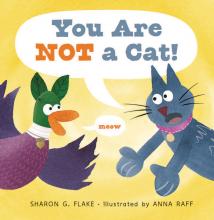
You Are NOT a Cat! by Sharon G. Flake


Photo from BoydMillsPress.com

In the best tradition of silly impersonation tales, You Are NOT a Cat takes us along as Duck and Cat debate the propriety of Duck’s expressions of identity. With clear comparisons to be made with the 2013 Elephant and Piggie series title I Am a Frog, this humorous read aloud prompts a second look for beginning readers.


The text of the book is set against white word bubbles, carving space out of the full bleed ink wash, pen, and pencil drawings. The text is a reasonable size for a beginning reader, the lines are short – generally 3-7 words - and feature sight words. The nature of the debate lends itself to some repetition – there are quite a few quacks and meows. 


As a picture book, You Are NOT a Cat contains direct and humorous illustrations. Duck’s leaf “ears” on the cover are a nice touch, and I enjoy Duck’s parrot imitation. But looking at the criteria, the presence of illustrations is insufficient – these illustrations must “demonstrate the story being told” and “function as keys or clues to the text”. The very plot rests on the tension between what is observably true – that Duck is a duck – and what is being stated – that he is a cat. But this kind of tension does not necessarily serve our beginning reader well. Instead of providing a clue to our reader, the illustrations are often directly contradicting what is being stated, starting on the very first page when Duck declares himself a cat. 


But wait – you might say – wait just a moment, “cat” is a three-letter word, a sight word, and there IS a cat on the page, after all. Aren’t we being a bit harsh? 


Let’s read on, I would reply. Because on the page describing a “long, straight tail” there is none present. Which is the entire point, of course. And while there are “whiskers” on the following page, just how well is the illustration providing clues to “tickle the air”? None of those new words will be repeated anywhere in the story.  Similarly, “makes nice music” and “parrot” and “rooster”and “cock-a-doodle-doo” go relatively unrepresented. To be fair Duck IS imitating a rooster when he uses those last two words, so were I on the committee I would defer to the beginners reads I was observing to see if Duck’s imitation is a sufficient clue for them. None of these things detract from the story’s humor or effectiveness as a read aloud, of course. But when evaluating it using the Geisel criteria, we must consider how the illustrations support the successful reading experience.


Similarly, the criteria state that “sentences must be simple and straightforward”. The presence of so many questions - “Now you’re a parrot, I suppose?” and “And tomorrow?” for example, may challenge the comprehension of our beginning reader. A beginning reader may struggle to read these questions with the appropriate expression, as they will not perceive the question mark until they’ve reached the end of the sentence. The committee would need to determine if the ten question marks in this story impact the successful experience of the beginning reader. 


Despite several elements supportive of the beginning reader, the effectiveness of the illustrations as clues to the text would hold me back from supporting You Are NOT a Cat! at the Geisel table. But I would only be one of seven votes - would it have a place on your ballot?

Monday, December 12, 2016

We Found a Hat by Jon Klassen

Two turtles. One hat. In Jon Klassen’s world, that’s a recipe for disaster. In this book, two turtles find a hat in the middle of the desert. Both turtles want the hat. Does one of them want it more than the other? In its deceptive simplicity, this book does a lot of things well when considered as a book for beginning readers. The text is large and clear, set in New Century Schoolbook, a standard serif font. As such, letters like “a” and “g” do not look like the ones children learn to write, but they do look like ones children will consistently encounter in print materials, including many beginning reader books. Most of the sentences are short, and the author eschews contractions. Nearly all of the words are simple one- or two-syllable words (the only three-syllable word is “together”), and repetition is used to great effect in the dialogue between the two turtles. Text is uniformly placed on an off-white background, either at the top of an illustrated page, or on a page facing an illustration.

The palpable longing that one turtle feels for the hat is deftly portrayed in Klassen’s illustrations, rendered in his signature palette of sepia and earth tones relieved only by the orange of the sunset. Also prominent in the artwork is some gentle humor: the hat is much too big for either turtle, but both are convinced that it looks good on them. Klassen’s art is bound to garner some attention from those who enjoy speculating on the Caldecott, but it brings up an interesting question for Geisel consideration. At one point in the middle of the book, and more extensively at the book’s conclusion, the storytelling relies entirely on wordless two-page spreads. According to the Geisel criteria, “The book must also contain illustrations, which function as keys or clues to the text,” and “The illustrations must demonstrate the story being told.” In the case of this book, the illustrations take over the storytelling at the end of the book. Does that run contrary to the Geisel criteria?


I would argue that this book does fall within the criteria, and it exemplifies many of the elements that the committee is charged with recognizing: short, simple sentences, gradual introduction of new vocabulary reinforced by plenty of repetition, and intriguing subject matter that will motivate children to read. What do you think? If you were on the committee, would this be one of your top picks?

Saturday, December 10, 2016

Duck, Duck, Porcupine by Salina Yoon

Today’s guest blogger is Kahla Gubanich. Kahla is a children’s and maker librarian at Carroll County Public Library in Maryland. 
Image from Duck, Duck, Porcupine
by Salina Yoon

In Duck, Duck, Porcupine by Salina Yoon, we are introduced to Little Duck, Big Duck, and Porcupine. The book contains three stories. In the first, the trio’s perfect picnic is nearly ruined by rain. In the second story, Big Duck has forgotten something very important, but all ends well when Big Duck remembers just in time to celebrate Porcupine’s birthday. Finally, the friends decide to go camping.

The simple sentences keep up a staccato beat throughout the book, and the words in the chapter titles are usually repeated several times within each story. Sentences are all fully contained on a single page and within the speech bubble. The content is not overly complicated and will likely be relatable to the reader: we have a soggy picnic that results in some great puddle jumping, a nearly-forgotten birthday that ends with a party, and exhaustive preparations for a camping trip that conclude satisfactorily with a crackling fire and some roasted marshmallows. In short, Duck, Duck, Porcupine has every initial appearance of a book for very early readers.

Image from Duck, Duck, Porcupine by Salina Yoon
The font choice generally echoes this conclusion. The text inside the characters’ speech bubbles is large and bold, suitable for beginning readers. For the most part, fonts outside the bubbles remain readable and even convey additional information to the reader. For example, as Little Duck grows bolder and begins to splash in the puddles with increasing gusto, the onomatopoeia text grows larger, showing the reader that the noise is louder. The font used for Big Duck’s extensive camping list has a handwritten quality, but remains large on the page.

There is one unfortunate exception to this: when Big Duck forgets Porcupine’s birthday, the reader’s only clues to the mysterious event come in the form of the tiny text on the gift tag, and on the birthday card in which Little Duck’s wing partially obscures the first letters. If the reader is unable to decode these clues, they remains just as in the dark as Big Duck about why the day is important and the story ultimately falls flat. A more experienced reader will decipher the partially-hidden words, but the very basic text and plot do not otherwise seem to target more experienced readers.

Image from Duck, Duck, Porcupine by Salina Yoon
The illustrations are bright and uncluttered, with saturated colors and bold outlines and a clean, whimsical style that will appeal to fans of Elephant & Piggie. In many instances the illustrations clearly reflect the text. When Big Duck refers to a string around her finger, the illustration clearly depicts her holding up one wing with a string tied around it. Yet the relationship between text and illustration varies, at times becoming an obstacle to the reading. Early in the book the characters head off-page to fetch the picnic basket and blanket one page before these items appear in the illustrations. Once the items do show up, the words are unfortunately not repeated.

On occasion, the illustrations and dialog even fail to align. Once the friends have assembled their picnic, Porcupine says, “Let’s go!” Yet the characters are all standing still, and the following image depicts them seated, apparently in the same spot. While relatively minor, these misalignments all create space for the reader to get lost within the text. These trickier interplays of text and image, combined with the well-hidden clues and more experienced visual literacy required to follow the plots, make Duck, Duck, Porcupine a seemingly simple book that requires a deceptively sophisticated reader.

What do you think? Have you read this book with a child? How did they navigate the text and illustrations?

Thursday, December 8, 2016

The Mixed-Up Truck by Stephen Savage

Images from us.macmillan.com
Today's post comes to us from Katya Schapiro, Senior Children's Librarian at the Bay Ridge Branch of the Brooklyn Public Library. She served on the 2016 Geisel Award committee, and has just joined the Quicklists Consulting Committee.

Steven Savage, author and illustrator of last year's Geisel Honor winning Supertruck, is back with another anthropomorphized tale of trucks. The Mixed-Up Truck is a hard-working but somewhat clueless cement mixer who, shades of Amelia Bedelia, just can’t quite get a handle on the correct execution of his job responsibilities. His efforts to “Mix up some powdery white cement” result in some tasty mishaps and not a little embarrassment, and it takes several tries until he and his fellow trucks can make a building.

Ah, vehicles. The superheroes of the toddler world. The draft animals of the city kid’s dreams. Those big, strong, active machines, with their distinctive noises, easily identified specialties, and 'community helper' vibe, are eternally and justifiably popular with young readers. In The Mixed-Up Truck, Savage employs many of the techniques that made Supertruck such a successful title for beginning readers, including large font text, short sentences and phrases, and a repetitive and episodic storytelling style.

Savage's signature digital art, which features bright colors, geometric cityscapes, and uncluttered (though rarely white) space is engaging, 'individually distinct,' and relaxing to readers in need of narrative clarity and visual rest. The characters themselves (the trucks) are cute and friendly looking, while still being easy to identify. Factory and construction site signage (“Danger,” “Sugar”) provide additional clues to the storytelling, allowing the savvy reader to get a jump on the plot reveals. Perhaps in honor of the 'powder' theme, nearly all of the illustrations are shaded in a stippled, powdery airbrush style.

The themes of The Mixed-Up Truck are those of perseverance in the face of initial failure, of getting up and trying again, and of using reading skills to succeed—perfect analogues for the struggles of a beginning reader. The repetitive unfolding of the story introduces new words slowly and builds reader confidence.

So far, so good. But I have some concerns as well. Throughout the book, the line breaks are built in every four or five words, rather than corresponding to sentences or even always to phrases. This works reasonably intuitively in sentences such as “All the other trucks/were hard at work,” or “The dump truck/was dumping,” but can get a little harder to follow in more complex sentences, such as “You got mixed up again,” said the/trucks,” or “The cement mixer mixed up/ the white powder, added a/little water, and presto!”


The juxtaposition of text and supportive illustration is also uneven, with some spreads reflecting and enhancing the text, and some offering very little information, or only supporting part of the page’s text. The plot, while building satisfactorily, relies on the assumption of knowledge that may or may not be in place (concrete is mixed from powder, sugar and flour make cake and icing), and might stretch the conceptual abilities of a reader who is already pushing their reading skills.

The Mixed-Up Truck is a great addition to Savage's vehicular adventure books, and truly shines when it shows the beauty of industrial buildings and the NYC skyline. While it's not perfectly calibrated as a beginning reader, I have no doubt that many readers young and old will appreciate its idiosyncratic storyline and powdery jokes.

Saturday, December 3, 2016

Up by Joe Cepeda


Our guest blogger today is Susan Kusel, a librarian, children's book buyer and selector at an independent bookstore, and the owner of a children's book consulting company. She has served on the Maryland Blue Crab Young Reader Award committee, the Cybils Easy Readers and Early Chapter Book Awards committee, the 2015 Caldecott Medal selection committee, and she is currently a member of the Sydney Taylor Book Award committee. She blogs at Wizards Wireless


Photo from HolidayHouse.com
The book cover begs a second look. It invites us to open this book to find out what on earth is happening in this delightfully upside down world.  

The gusts of wind propel each page turn, starting with the cover, moving through the endpapers and into the body of the book. The stage is set and we know that we are in for a blustery day.

This is truly a book for an early reader. The font is black, clear and easy to read. All the text (except for one sentence) is against plain, white backgrounds.

There are twelve unique words in the book, and each one is short, no longer than one syllable or five letters.  No sentence is longer than four words. Words and phrases are repeated. Clear visual clues are present when new words are introduced.

The illustrations and the story carry us along from start to finish, because we have no idea what will happen to this euphoric child floating through the air with his magic pinwheel. Despite the simple text, we are compelled to find out what happens next.

It remains to be seen if the Geisel committee will consider this book distinguished. But if you have very early readers in your life, I hope you take a look at this book and enjoy the ride.