
 It’s a classic story. The perky optimist meets the dour naysayer and the two become friends. Vicky Fang’s version of the well-loved trope features two robots with simple, expressive shapes, a sunny circle and a morose square who cross paths in the schoolyard.
Purple square Block sits alone, watching the other boisterous bots, when blue circle Blink appears, using a sensor to scan the ground for treasure. Block reacts to each of Blink’s finds with predictable gloom (“That’s . . . a gum wrapper/With old gum in it”) but Blink persists. When they unearth a penny, Blink spins the discovery into the opportunity to make a wish. Though Block concludes the wish has been a bust (“I don’t see any gold. Or silver. Or gems!”), Blink knows better: The upbeat bot had really wished for a new friend.
The visuals match the narrative in lively simplicity. A straightforward comics format and generic backgrounds keep the focus squarely on the friends, with one or both robots centered in each symmetrical panel. Word balloons offer a clear, non-serif font with ample white space and occasional bold words. In a potentially confusing decision, the word balloons are white when set against the schoolyard background but have a tinted hue matching their speaker when set against a white bleed panel. This means that the same robot may have different-colored speech balloons within the same spread. New comics readers may find the switch confusing, though the placement and balloon tails help clarify the speaker.
The word choice includes some challenging vocabulary words (wrapper, probably, treasure) with minimal repetition, so this text works best for kids already comfortable with basic sight words. But the book also supports learning around comics literacy and robots. An opening page explains cartooning basics, in small text most likely designed for adults to share with kids. Back matter explains “What is a sensor?” highlighting the mechanical features both robots used to search for treasure.
With a popular format and modern-age protagonists--what else could robots be?--this updated take on a classic trope might just ping those Geisel sensors.
It’s a classic story. The perky optimist meets the dour naysayer and the two become friends. Vicky Fang’s version of the well-loved trope features two robots with simple, expressive shapes, a sunny circle and a morose square who cross paths in the schoolyard.
Purple square Block sits alone, watching the other boisterous bots, when blue circle Blink appears, using a sensor to scan the ground for treasure. Block reacts to each of Blink’s finds with predictable gloom (“That’s . . . a gum wrapper/With old gum in it”) but Blink persists. When they unearth a penny, Blink spins the discovery into the opportunity to make a wish. Though Block concludes the wish has been a bust (“I don’t see any gold. Or silver. Or gems!”), Blink knows better: The upbeat bot had really wished for a new friend.
The visuals match the narrative in lively simplicity. A straightforward comics format and generic backgrounds keep the focus squarely on the friends, with one or both robots centered in each symmetrical panel. Word balloons offer a clear, non-serif font with ample white space and occasional bold words. In a potentially confusing decision, the word balloons are white when set against the schoolyard background but have a tinted hue matching their speaker when set against a white bleed panel. This means that the same robot may have different-colored speech balloons within the same spread. New comics readers may find the switch confusing, though the placement and balloon tails help clarify the speaker.
The word choice includes some challenging vocabulary words (wrapper, probably, treasure) with minimal repetition, so this text works best for kids already comfortable with basic sight words. But the book also supports learning around comics literacy and robots. An opening page explains cartooning basics, in small text most likely designed for adults to share with kids. Back matter explains “What is a sensor?” highlighting the mechanical features both robots used to search for treasure.
With a popular format and modern-age protagonists--what else could robots be?--this updated take on a classic trope might just ping those Geisel sensors.

Tuesday, November 30, 2021
Friendbots: Blink and Block Make a Wish by Vicky Fang

Tuesday, November 23, 2021
“If you can catch it, you can keep it!”

Sylvie Shaffer served on the 2018 Geisel Committee. She’s the preK-8 librarian at the Capitol Hill Day School in Washington, DC and is active in several overlapping kidlit-focused communities including ALSC and Capitol Choices, and has also served on the 2019 and 2020 Sydney Taylor Book Awards. You can find her online at www.SylvieJuliet.Shaffer.com
Starla Jean’s resolve to capture the chicken she happens upon in the park (her dad naively promised “if you can catch it, you can keep it” ) is mirrored by emerging readers’ determination to read this title independently- and like Starla Jean, they gleefully succeed with pride.
At 96 pages, Starla Jean kisses the upper page limit of the Geisel Criteria, and not a page is wasted. The longer format is only one of many reasons this book has been a hit with the first and second grade emerging readers in my school library. Kids feel a terrific sense of accomplishment having read a book just shy of a hundred pages, and the book’s standout design, storytelling, word choice, and illustrations work together to pace a reading experience that provides a perfect balance of stamina-building forward momentum, and welcome pauses.
The whimsical and appealing illustrations feel both modern and timeless, and provide support for the handful of challenging or un-decodable words that appear throughout the text (for example, “laughing”, “laundry”, “diaper.”) Other tricky words are repeated to help readers conquer them; “treasure” appears early in the story and is later repeated three times within a few sentences as the story winds down, ensuring the next time a reader encounters the word, they’ll likely recognize it.
 The first person narration contains a variety of sentence structures and punctuation, along with plenty of dialogue, providing practice to readers still learning to parse these conventions of text. It also breaks the fourth wall, asking readers “Do you remember how I told you…” doing double duty of keeping readers engaged and offering practice at some reading skills beyond decoding: retelling, prediction, inferring.
Design, both of individual pages, and the book’s overall aesthetic play a strong hand in its success. A family portrait facing the first chapter’s header introduces the family, hinting at members' personalities. The pops of red against an otherwise muted palette is brilliant and connects Starla Jean (in red boots and a striped long sleeve shirt, paired with a blue jumper) to the chicken’s comb, wattle, legs and tail feathers- tipped blue to match Starla Jean’s jumper) while the red, handwritten, onomatopoeic interjections (bawk, scritch, meow) beg to be read aloud. Although the text could easily have worked as a longer picture book, dividing it into four neat chapters makes it easy for an emerging reader to tackle this all at once, or a bit at a time as best suits their needs and desires.
The first person narration contains a variety of sentence structures and punctuation, along with plenty of dialogue, providing practice to readers still learning to parse these conventions of text. It also breaks the fourth wall, asking readers “Do you remember how I told you…” doing double duty of keeping readers engaged and offering practice at some reading skills beyond decoding: retelling, prediction, inferring.
Design, both of individual pages, and the book’s overall aesthetic play a strong hand in its success. A family portrait facing the first chapter’s header introduces the family, hinting at members' personalities. The pops of red against an otherwise muted palette is brilliant and connects Starla Jean (in red boots and a striped long sleeve shirt, paired with a blue jumper) to the chicken’s comb, wattle, legs and tail feathers- tipped blue to match Starla Jean’s jumper) while the red, handwritten, onomatopoeic interjections (bawk, scritch, meow) beg to be read aloud. Although the text could easily have worked as a longer picture book, dividing it into four neat chapters makes it easy for an emerging reader to tackle this all at once, or a bit at a time as best suits their needs and desires.
 While not a Geisel Award criteria, there are some terrific messages both overt and subtle that are nested (ha!) here too: grit and determination are often rewarding; when something isn’t working for a member of the household, (chicken poop in the house? yikes!) be proactive in seeking a solution; do one’s best to return lost items; Dads can and should take active parenting roles (folding laundry, biking to the park.)
Starla Jean is worthy of a Geisel, and I’m hopeful The Real Committee thinks so, too!
While not a Geisel Award criteria, there are some terrific messages both overt and subtle that are nested (ha!) here too: grit and determination are often rewarding; when something isn’t working for a member of the household, (chicken poop in the house? yikes!) be proactive in seeking a solution; do one’s best to return lost items; Dads can and should take active parenting roles (folding laundry, biking to the park.)
Starla Jean is worthy of a Geisel, and I’m hopeful The Real Committee thinks so, too!
Tuesday, November 16, 2021
"I'm ON It!" Is on-point for Geisel Consideration

 Taylor Worley (she/her) is a Youth Services Librarian for Springfield Public Library in Oregon. When not reading, she’s typically gaming, creating something, or collecting bits of nature. You can find her in various online communities at @magpiebricolage, @magpiemakesstuff, or @magpiereadsstuff.
Andrea Tsurumi is so on it with her contribution to the Elephant & Piggie Like Reading! series, “I’m ON It!” In the familiar and inviting style of the established series, Tsurumi excels in telling a cumulative story with minimal text.
When Frog sees Goat up on a tree stump, they are duly impressed. Eager to follow, Frog jumps upon a boulder. Not to be outdone, Goat picks up a tire to be, “...on it AND beside it!” Frog follows again, and on and on the duo goes until they are both, “...on it, along it, above it, inside it, through it, and AROUND it!” When Goat gloats, “I AM SO INTO THIS!” Frog realizes they certainly are not, and lets their tower crash to the pond below. Happily kicking back on a lily pad, Frog croaks, “I am OVER it.” Goat realizes that they, too, are over it, splashing into the pond and alleviating any tensions in the friendship. There is no question that “I’m ON It!” is an exceptional introduction to reading. The illustrations are funny with crisp, bright colors, and the text is approachable and engaging. When considering the specific criteria of the Geisel Award, does “I’m ON It!” still measure up? Absolutely.
The Geisel Award criteria require that works provide a “page turning”, “stimulating and successful reading experience” for beginning readers. Tsurumi handily accomplishes this by building a scaffold in both the text and illustrations. Each page turn adds one extra element to Goat and Frog’s competition, with an added bonus of spatial reasoning. “I’m on it! … I’m on it and beside it! … I’m on it and beside it and inside it!” This format also exemplifies the criteria that words be gradually added and frequently repeated for the benefit of the reader. Not only does Goat repeat every element of the competition with each addition, but Frog also echoes Goat.
As required by the award criteria, the illustrations clearly “demonstrate the story being told” and effectively “function as keys or clues to the text.” Tsurumi uses clear, medium-weight, black outlines for clean fields of color. The palette is cheerful and clean, with tonal accents to add dimension. Speech bubbles get priority placement, further emphasizing text and directing the reader’s attention. Those that linger on the silly scenes will notice fun details, including a familiar pigeon in flight.
There is no question that “I’m ON It!” is an exceptional introduction to reading. The illustrations are funny with crisp, bright colors, and the text is approachable and engaging. When considering the specific criteria of the Geisel Award, does “I’m ON It!” still measure up? Absolutely.
The Geisel Award criteria require that works provide a “page turning”, “stimulating and successful reading experience” for beginning readers. Tsurumi handily accomplishes this by building a scaffold in both the text and illustrations. Each page turn adds one extra element to Goat and Frog’s competition, with an added bonus of spatial reasoning. “I’m on it! … I’m on it and beside it! … I’m on it and beside it and inside it!” This format also exemplifies the criteria that words be gradually added and frequently repeated for the benefit of the reader. Not only does Goat repeat every element of the competition with each addition, but Frog also echoes Goat.
As required by the award criteria, the illustrations clearly “demonstrate the story being told” and effectively “function as keys or clues to the text.” Tsurumi uses clear, medium-weight, black outlines for clean fields of color. The palette is cheerful and clean, with tonal accents to add dimension. Speech bubbles get priority placement, further emphasizing text and directing the reader’s attention. Those that linger on the silly scenes will notice fun details, including a familiar pigeon in flight.

 With all award requirements met (e.g. at least 24 but not more than 96 pages) and a strong showing in the core criteria, Goat and Frog should certainly be at the table for Geisel Award discussions this year. Regardless of final medals, however, they decidedly deserve a place on your early reader shelves. Let’s hope we see more of this duo in the future!
Tuesday, November 9, 2021
Fox at Night by Corey R. Tabor
This week we're thrilled to have another post from Jackie Partch, assessing a new entry by 2019 Geisel winning creator Corey Tabor. Jackie Partch is a School Corps Librarian at Multnomah County Library, where she does outreach to K-12 students. She was a member of the 2012 Geisel committee.

The main character of the 2019 Geisel winner, Fox the Tiger, returns in this title. The story begins with Fox in a tent at nighttime, looking frightened. The simple text accompanying the illustration reads, “It is night, and Fox is scared.” Readers are immediately drawn in--why is Fox afraid? The next page lets us know: “The night is full of monsters,” says Fox. Already, this book has met one of the Geisel criteria: subject matter intriguing enough to motivate a child reader.
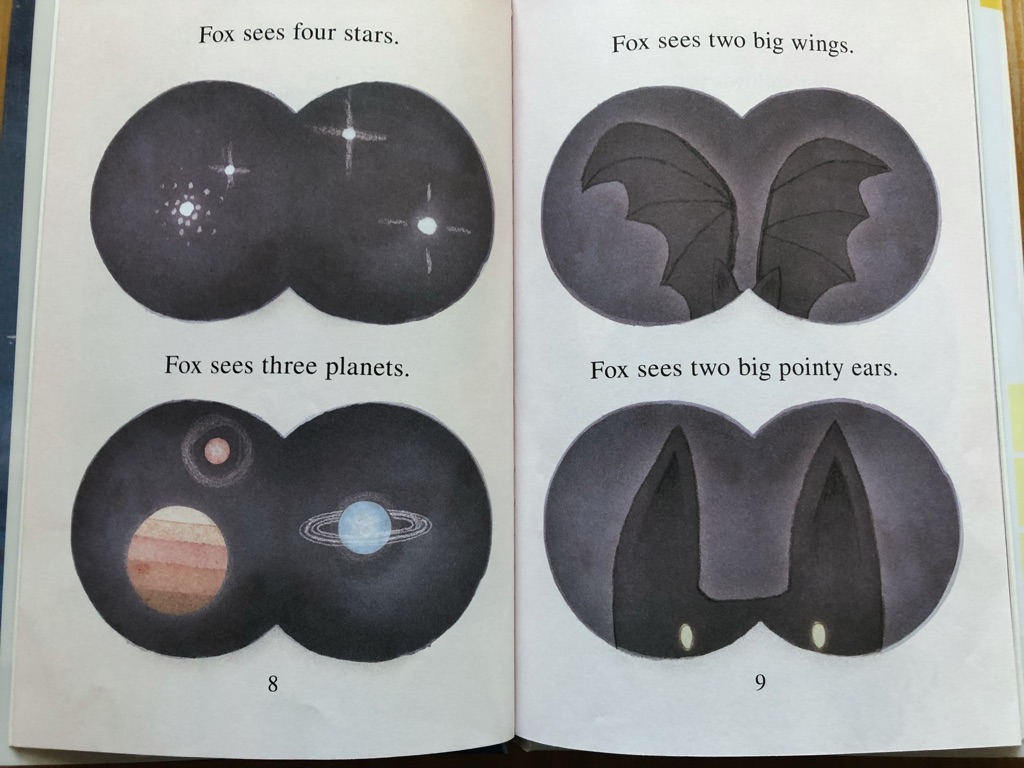
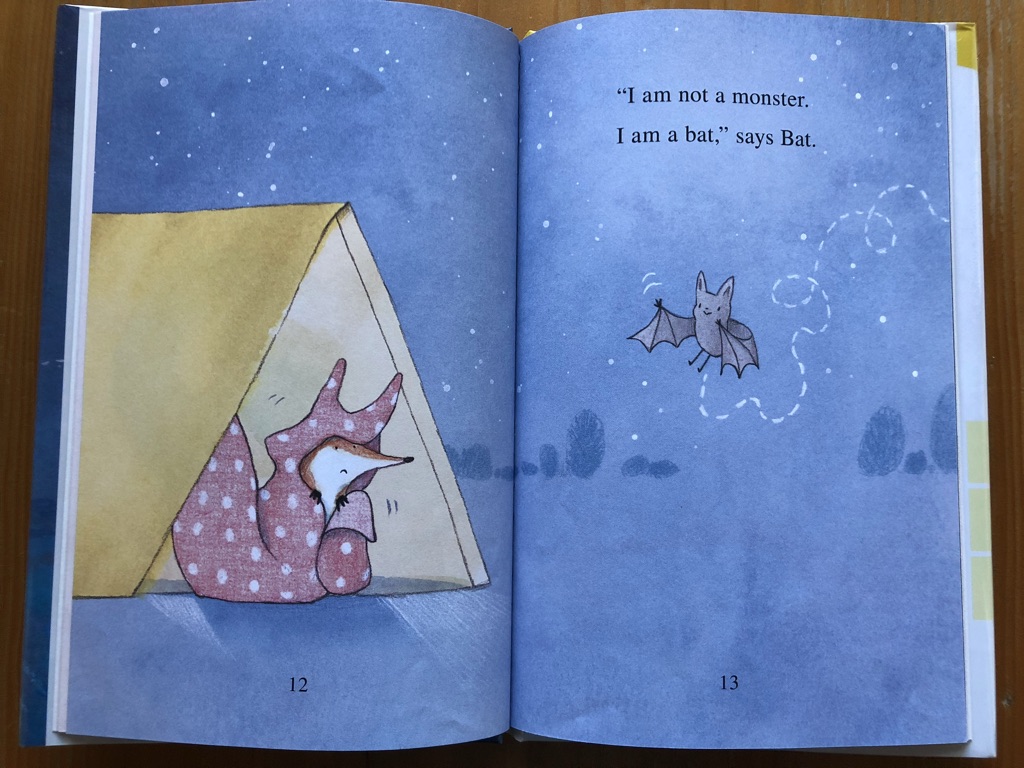
Another Geisel criteria is that the plot should advance and create a “page-turning dynamic.” Fox’s humorous misidentification of animals definitely keeps readers engaged (they’ll enjoy being able to identify some “monsters” before Fox does). And they may be wondering: Is Fox always wrong? Or are there monsters out at night? The book design of Fox at Night is also spot-on for a beginning reader. The large type size has plenty of spacing between lines, and the line length is usually quite short. The text always appears on an uncluttered background, even when the illustration covers the whole page. So, is this book distinguished enough to win the Geisel? Is it a “stimulating and successful reading experience”? I think so! Please share your thoughts in the comments.
Tuesday, November 2, 2021
A savory mix of acceptance and calamari - Kraken Me Up by Jeffrey Ebbeler
We're so lucky this week to have another post by the incredibly talented Betsy Bird! Betsy Bird is the Collection Materials Specialist of Evanston Public Library and the former Youth Materials Specialist of New York Public Library. She reviews for Kirkus, runs the School Library Journal blog A Fuse #8 Production, hosts the podcast Story Seeds, and runs the podcast Fuse 8 n’ Kate. Betsy is the author such books as LONG ROAD TO THE CIRCUS, her debut middle grade novel out this fall, with art by David Small.
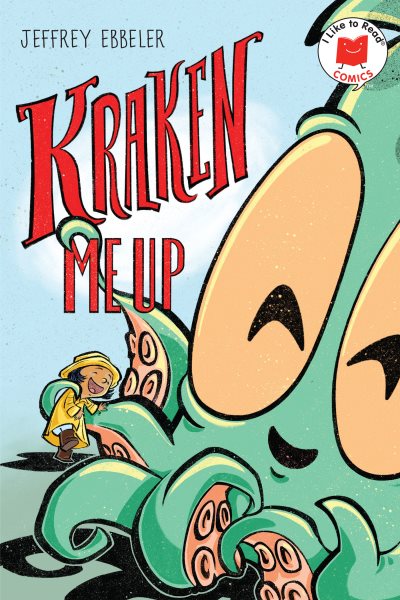
I confess that upon reading Jeffrey Ebbeler’s near perfect easy book KRAKEN ME UP I felt distinctly miffed. As far as I’m concerned, if an author/artist has the necessary skills and wherewithal to produce a legitimately good and original easy book, why would they shine their lights under bushels until now? Well, the fact of the matter is that in the case of Mr. Ebbeler, he’s been in the picture book game a very long time. Take a gander at his website and you’ll see a large number of familiar titles on display including (I’d like to note) an entire easy reader series called We Read Phonics from around a decade ago. No stranger to the easy reading format, Ebbeler has clearly taken care to hone his skills over the past few years. The end result is the aforementioned KRAKEN ME UP, a book that manages to both have a story worth remembering (two words: pet Kraken) as well as words that fall perfectly within the purview of a beginning readership. This tale begins at a setting worthy of CHARLOTTE’S WEB itself. When a little girl brings her pet to the county fair pet show, no one thinks much of it. That is, until they notice that it’s a humungous, hard-to-miss Kraken! As pets go, this one’s a standout, and certainly there are prejudices to overcome. Yet after the Kraken, subjected to fear on the part of the other children, has a good sulk in a pond, a solution is reached, beneficial to one and all. All told, this is an exceedingly sweet and subtle tale of acceptance and calamari. I’m sure we’re all familiar with easy books that strain at the tensile strength of that ambiguous term “easy”. What sets this book apart is its absolute commitment to words of a particularly basic construction. The actual word “kraken” is an odd one, I would grant, but there are few phrases here more complex than your standard “pretty pig” and “fine hen”. Additionally, I would also like to award some extra points to Holiday House for publishing this book at the standard 9 X 6 inches. As many a librarian will tell you, attempts to shelve their oversized I Like to Read series on our library shelves over the years proved to be a losing proposition. After all, easy book shelves are significantly smaller than picture book shelves. Happily, KRAKEN ME UP clocks in at a mere 9.25 inches high and 6.25 inches wide. This book is also just as adorable as its cover implies, and, after finishing it, both kids and their gatekeepers will find themselves hoping for more Kraken books real soon.
Tuesday, October 26, 2021
The Rock From the Sky by Jon Klassen
This week we're delighted to have a post by Jackie Partch. Jackie Partch is a School Corps Librarian at Multnomah County Library, where she does outreach to K-12 students. She was a member of the 2012 Geisel committee.

A turtle, armadillo and snake (all wearing hats, of course) narrowly escape death while also navigating friendship troubles in the five chapters in this book. Klassen’s signature dark humor is evident, and these characters have those expressive eyes, found in most of his books, which are so effective in conveying emotion. How does the book stack up to the Geisel criteria, though? The Geisel award is given to the “most distinguished contribution to the body of American children’s literature that encourages and supports the beginning reader.” One of the definitions of distinguished is “individually distinct,” and this picture book with 96 pages (the upper range for the Geisel award) is certainly unlike most other beginning readers. Klassen is a master of pacing, and the “page-turning dynamic” is especially strong in chapter one, when the turtle shows off his favorite spot, but on the next page, readers see a rock hurtling towards it. Can the oblivious turtle be convinced to move in time? Similarly, in the last chapter, an alien creature with a gigantic laser eyeball appears to be ready to zap the (still oblivious) turtle. I know I was enticed to keep turning the pages to see what would happen. Giant rocks and aliens aside, the subject matter will be familiar to children. The turtle has an especially childlike personality, insisting to Armadillo that he doesn’t need help and is not tired. He also feels excluded when his friends hang out under the rock without him. A Geisel winner should create “a successful reading experience, from start to finish,” and the surprise ending to this story (it turns out there is more than one rock from the sky), definitely leaves the reader feeling satisfied as the story comes full circle.

The Rock from the Sky also has simple, straightforward sentences, text in a large font on an uncluttered background, and the characters frequently repeat newly introduced words in their conversations. I did have a few quibbles with this title. Some more challenging words (actually, enough, future) are included without visual support. Multiple times when characters were shouting, it was conveyed in all caps, which can be more challenging to read. In addition, like Klassen’s other books, the text is in different colors to show which character is speaking. This time, the colors are very similar, and when I read the book in different lighting, I noticed sometimes it could be more difficult to tell them apart. I wonder if first-time Klassen readers (are there any kids who haven’t already read a Jon Klassen book?) would be confused. Have you heard from kids who have read this book on their own? What were their opinions? Please leave a comment to let us know!
Tuesday, October 19, 2021
Tag Team (back again)

We're thankful this week to have a post by Betsy Bird. Betsy is the Collection Materials Specialist of Evanston Public Library and the former Youth Materials Specialist of New York Public Library. She reviews for Kirkus, runs the School Library Journal blog A Fuse #8 Production, hosts the podcast Story Seeds, and runs the podcast Fuse 8 n’ Kate. Betsy is the author such books as LONG ROAD TO THE CIRCUS, her debut middle grade novel out NOW, with art by David Small.
 About ten years ago, as I was working at New York Public Library’s Children’s Center at 42nd Street, we hosted a class of local schoolchildren. After our standard presentation they were allowed to come to the reference desk to ask for books on specific topics. All at once ten kids were in front of me, all asking the same thing: “Where are your books on Mexican wrestlers?” A decade or more has passed since I received that query and yet the answer has remained fairly static. There just ain’t that much out there, kids.
Until now.
Who could have predicted that Raul the Third would be so adept at spinning off side characters from his popular Vamos! picture book series into easy books of their own? And, even better, side characters with direct ties to the sport of Mexican wrestling? Tag Team and Training Day both star El Toro, a masked Mexican wrestling hero who is not without flaws. In Training Day El Toro needs to practice but, much to the dismay of his coach (a rooster named Kooky Dooky), he keeps avoiding it. In Training Day El Toro and his partner La Oink Oink discover that they must take matters into their own hands when they find that their beloved wrestling stadium is a complete mess.
Both books inject a much needed shot of adrenaline into the easy book format. Not only are the colors bright, eye-popping, and vibrant, but the content is brimming with excitement. Sure, one of the books focuses primarily on cleaning, but when you’ve got El Toro and La Oink Oink doing the work it’s anything but dull. I’d also like to pay special tribute to the plot of Tag Team. The book takes pains to show that when El Toro discovers that the stadium is in disarray, he doesn’t call up the female La Oink Oink to help him clean up because she’s a girl. Instead, it is the equality of the two that makes them an excellent team. El Toro calls her up because she is his partner, sharing both the victories and the hardships that come with that relationship. This is a book about being a team through both the good and the bad.
As for the language, simple words are the norm. It is also worth noting that incorporating Spanish words and terms into easy books is a splendid method of paying tribute not merely to Mexican and Mexican-American culture, but also to the importance of normalizing other languages in our easiest literature for youth.
With any luck, perhaps these books will mark a new trend in culturally explorative, exciting easy book fare. So long, Dick and Jane! With El Toro and friends, they’re here to save the day from the banal and mundane once and for all.
About ten years ago, as I was working at New York Public Library’s Children’s Center at 42nd Street, we hosted a class of local schoolchildren. After our standard presentation they were allowed to come to the reference desk to ask for books on specific topics. All at once ten kids were in front of me, all asking the same thing: “Where are your books on Mexican wrestlers?” A decade or more has passed since I received that query and yet the answer has remained fairly static. There just ain’t that much out there, kids.
Until now.
Who could have predicted that Raul the Third would be so adept at spinning off side characters from his popular Vamos! picture book series into easy books of their own? And, even better, side characters with direct ties to the sport of Mexican wrestling? Tag Team and Training Day both star El Toro, a masked Mexican wrestling hero who is not without flaws. In Training Day El Toro needs to practice but, much to the dismay of his coach (a rooster named Kooky Dooky), he keeps avoiding it. In Training Day El Toro and his partner La Oink Oink discover that they must take matters into their own hands when they find that their beloved wrestling stadium is a complete mess.
Both books inject a much needed shot of adrenaline into the easy book format. Not only are the colors bright, eye-popping, and vibrant, but the content is brimming with excitement. Sure, one of the books focuses primarily on cleaning, but when you’ve got El Toro and La Oink Oink doing the work it’s anything but dull. I’d also like to pay special tribute to the plot of Tag Team. The book takes pains to show that when El Toro discovers that the stadium is in disarray, he doesn’t call up the female La Oink Oink to help him clean up because she’s a girl. Instead, it is the equality of the two that makes them an excellent team. El Toro calls her up because she is his partner, sharing both the victories and the hardships that come with that relationship. This is a book about being a team through both the good and the bad.
As for the language, simple words are the norm. It is also worth noting that incorporating Spanish words and terms into easy books is a splendid method of paying tribute not merely to Mexican and Mexican-American culture, but also to the importance of normalizing other languages in our easiest literature for youth.
With any luck, perhaps these books will mark a new trend in culturally explorative, exciting easy book fare. So long, Dick and Jane! With El Toro and friends, they’re here to save the day from the banal and mundane once and for all.