Pages

Tuesday, November 9, 2021

Fox at Night by Corey R. Tabor

This week we're thrilled to have another post from Jackie Partch, assessing a new entry by 2019 Geisel winning creator Corey Tabor. Jackie Partch is a School Corps Librarian at Multnomah County Library, where she does outreach to K-12 students. She was a member of the 2012 Geisel committee.


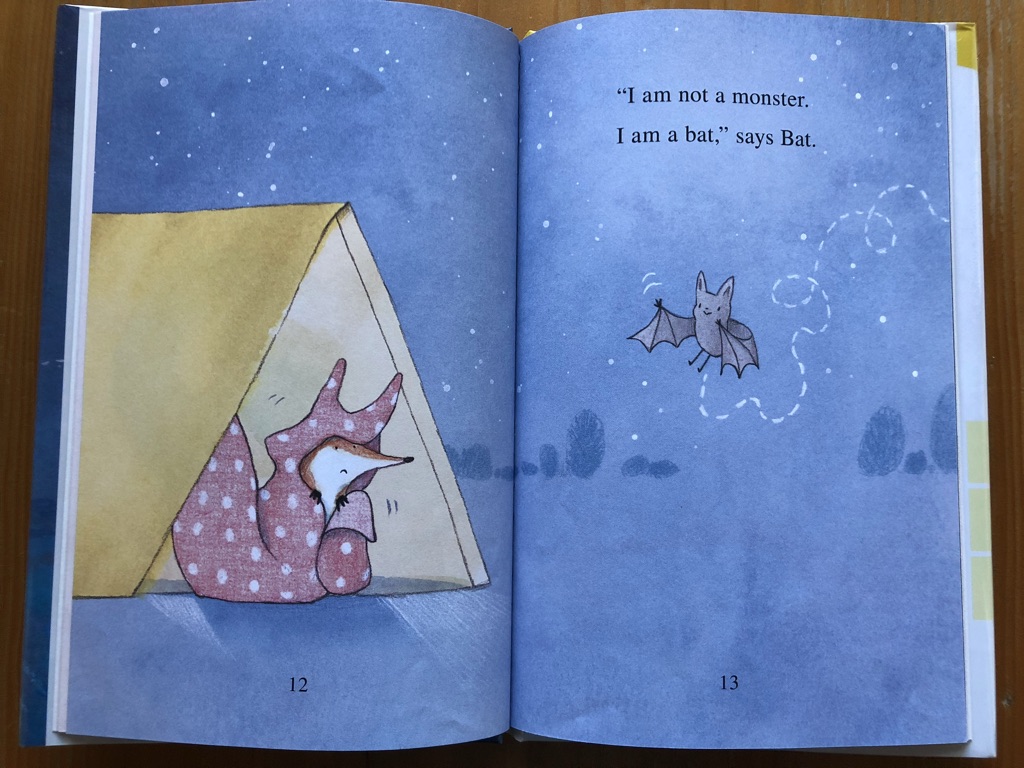
The main character of the 2019 Geisel winner, Fox the Tiger, returns in this title. The story begins with Fox in a tent at nighttime, looking frightened. The simple text accompanying the illustration reads, “It is night, and Fox is scared.” Readers are immediately drawn in--why is Fox afraid? The next page lets us know: “The night is full of monsters,” says Fox. Already, this book has met one of the Geisel criteria: subject matter intriguing enough to motivate a child reader. 
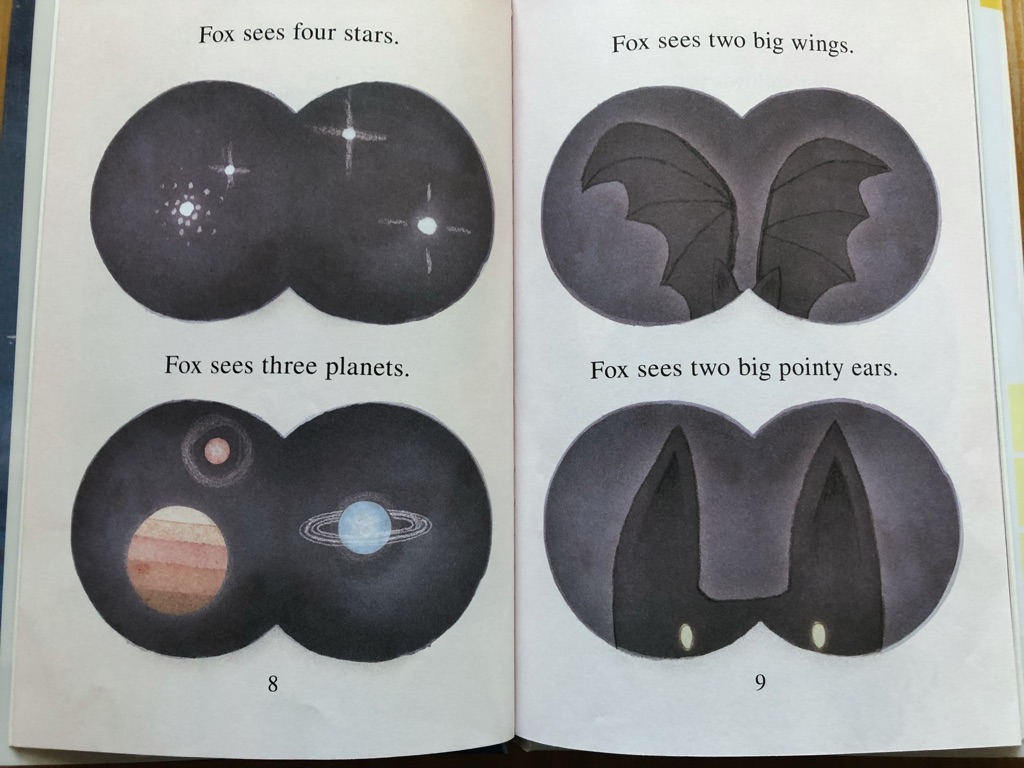
 As Fox peers through his binoculars, he spies stars and planets as well as something suspicious: two big wings and two pointy ears! Is it a monster? The illustrations on this spread serve as keys or clues to the text (another Geisel criteria). Each time a new word is introduced, it appears in a separate illustration to help new readers figure it out. In addition, words are frequently repeated: Fox regularly comments that “the night is full of monsters,” and the non-monstrous animals he meets respond in a patterned format: “I am not a monster. I am a ___.” Sentences are simple and straightforward with an average of 5-8 words each.

Another Geisel criteria is that the plot should advance and create a “page-turning dynamic.” Fox’s humorous misidentification of animals definitely keeps readers engaged (they’ll enjoy being able to identify some “monsters” before Fox does). And they may be wondering: Is Fox always wrong? Or are there monsters out at night? The book design of Fox at Night is also spot-on for a beginning reader. The large type size has plenty of spacing between lines, and the line length is usually quite short. The text always appears on an uncluttered background, even when the illustration covers the whole page. So, is this book distinguished enough to win the Geisel? Is it a “stimulating and successful reading experience”? I think so! Please share your thoughts in the comments.

Tuesday, November 2, 2021

A savory mix of acceptance and calamari - Kraken Me Up by Jeffrey Ebbeler

We're so lucky this week to have another post by the incredibly talented Betsy Bird! Betsy Bird is the Collection Materials Specialist of Evanston Public Library and the former Youth Materials Specialist of New York Public Library. She reviews for Kirkus, runs the School Library Journal blog A Fuse #8 Production, hosts the podcast Story Seeds, and runs the podcast Fuse 8 n’ Kate. Betsy is the author such books as LONG ROAD TO THE CIRCUS, her debut middle grade novel out this fall, with art by David Small. 


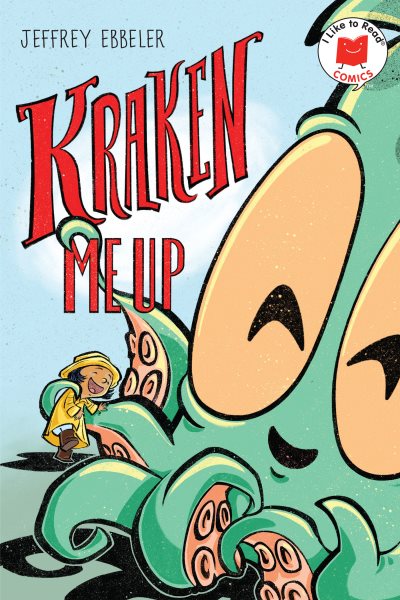
I confess that upon reading Jeffrey Ebbeler’s near perfect easy book KRAKEN ME UP I felt distinctly miffed. As far as I’m concerned, if an author/artist has the necessary skills and wherewithal to produce a legitimately good and original easy book, why would they shine their lights under bushels until now? Well, the fact of the matter is that in the case of Mr. Ebbeler, he’s been in the picture book game a very long time. Take a gander at his website and you’ll see a large number of familiar titles on display including (I’d like to note) an entire easy reader series called We Read Phonics from around a decade ago. No stranger to the easy reading format, Ebbeler has clearly taken care to hone his skills over the past few years. The end result is the aforementioned KRAKEN ME UP, a book that manages to both have a story worth remembering (two words: pet Kraken) as well as words that fall perfectly within the purview of a beginning readership.

  This tale begins at a setting worthy of CHARLOTTE’S WEB itself. When a little girl brings her pet to the county fair pet show, no one thinks much of it. That is, until they notice that it’s a humungous, hard-to-miss Kraken! As pets go, this one’s a standout, and certainly there are prejudices to overcome. Yet after the Kraken, subjected to fear on the part of the other children, has a good sulk in a pond, a solution is reached, beneficial to one and all. All told, this is an exceedingly sweet and subtle tale of acceptance and calamari. I’m sure we’re all familiar with easy books that strain at the tensile strength of that ambiguous term “easy”. What sets this book apart is its absolute commitment to words of a particularly basic construction. The actual word “kraken” is an odd one, I would grant, but there are few phrases here more complex than your standard “pretty pig” and “fine hen”. Additionally, I would also like to award some extra points to Holiday House for publishing this book at the standard 9 X 6 inches. As many a librarian will tell you, attempts to shelve their oversized I Like to Read series on our library shelves over the years proved to be a losing proposition. After all, easy book shelves are significantly smaller than picture book shelves. Happily, KRAKEN ME UP clocks in at a mere 9.25 inches high and 6.25 inches wide. This book is also just as adorable as its cover implies, and, after finishing it, both kids and their gatekeepers will find themselves hoping for more Kraken books real soon.

Tuesday, October 26, 2021

The Rock From the Sky by Jon Klassen

This week we're delighted to have a post by Jackie Partch. Jackie Partch is a School Corps Librarian at Multnomah County Library, where she does outreach to K-12 students. She was a member of the 2012 Geisel committee.


A turtle, armadillo and snake (all wearing hats, of course) narrowly escape death while also navigating friendship troubles in the five chapters in this book. Klassen’s signature dark humor is evident, and these characters have those expressive eyes, found in most of his books, which are so effective in conveying emotion. How does the book stack up to the Geisel criteria, though?

  The Geisel award is given to the “most distinguished contribution to the body of American children’s literature that encourages and supports the beginning reader.” One of the definitions of distinguished is “individually distinct,” and this picture book with 96 pages (the upper range for the Geisel award) is certainly unlike most other beginning readers. Klassen is a master of pacing, and the “page-turning dynamic” is especially strong in chapter one, when the turtle shows off his favorite spot, but on the next page, readers see a rock hurtling towards it. Can the oblivious turtle be convinced to move in time? Similarly, in the last chapter, an alien creature with a gigantic laser eyeball appears to be ready to zap the (still oblivious) turtle. I know I was enticed to keep turning the pages to see what would happen. Giant rocks and aliens aside, the subject matter will be familiar to children. The turtle has an especially childlike personality, insisting to Armadillo that he doesn’t need help and is not tired. He also feels excluded when his friends hang out under the rock without him. A Geisel winner should create “a successful reading experience, from start to finish,” and the surprise ending to this story (it turns out there is more than one rock from the sky), definitely leaves the reader feeling satisfied as the story comes full circle. 
 
 The Rock from the Sky also has simple, straightforward sentences, text in a large font on an uncluttered background, and the characters frequently repeat newly introduced words in their conversations. I did have a few quibbles with this title. Some more challenging words (actually, enough, future) are included without visual support. Multiple times when characters were shouting, it was conveyed in all caps, which can be more challenging to read. In addition, like Klassen’s other books, the text is in different colors to show which character is speaking. This time, the colors are very similar, and when I read the book in different lighting, I noticed sometimes it could be more difficult to tell them apart. I wonder if first-time Klassen readers (are there any kids who haven’t already read a Jon Klassen book?) would be confused. Have you heard from kids who have read this book on their own? What were their opinions? Please leave a comment to let us know!

Tuesday, October 19, 2021

Tag Team (back again)

Cover of El Toro & Friends Training Day


We're thankful this week to have a post by Betsy Bird. Betsy is the Collection Materials Specialist of Evanston Public Library and the former Youth Materials Specialist of New York Public Library. She reviews for Kirkus, runs the School Library Journal blog A Fuse #8 Production, hosts the podcast Story Seeds, and runs the podcast Fuse 8 n’ Kate. Betsy is the author such books as LONG ROAD TO THE CIRCUS, her debut middle grade novel out NOW, with art by David Small.

Cover of El Toro & Friends Tag TeamAbout ten years ago, as I was working at New York Public Library’s Children’s Center at 42nd Street, we hosted a class of local schoolchildren. After our standard presentation they were allowed to come to the reference desk to ask for books on specific topics. All at once ten kids were in front of me, all asking the same thing: “Where are your books on Mexican wrestlers?” A decade or more has passed since I received that query and yet the answer has remained fairly static. There just ain’t that much out there, kids. Until now. Who could have predicted that Raul the Third would be so adept at spinning off side characters from his popular Vamos! picture book series into easy books of their own? And, even better, side characters with direct ties to the sport of Mexican wrestling? Tag Team and Training Day both star El Toro, a masked Mexican wrestling hero who is not without flaws. In Training Day El Toro needs to practice but, much to the dismay of his coach (a rooster named Kooky Dooky), he keeps avoiding it. In Training Day El Toro and his partner La Oink Oink discover that they must take matters into their own hands when they find that their beloved wrestling stadium is a complete mess. Both books inject a much needed shot of adrenaline into the easy book format. Not only are the colors bright, eye-popping, and vibrant, but the content is brimming with excitement. Sure, one of the books focuses primarily on cleaning, but when you’ve got El Toro and La Oink Oink doing the work it’s anything but dull. I’d also like to pay special tribute to the plot of Tag Team. The book takes pains to show that when El Toro discovers that the stadium is in disarray, he doesn’t call up the female La Oink Oink to help him clean up because she’s a girl. Instead, it is the equality of the two that makes them an excellent team. El Toro calls her up because she is his partner, sharing both the victories and the hardships that come with that relationship. This is a book about being a team through both the good and the bad. As for the language, simple words are the norm. It is also worth noting that incorporating Spanish words and terms into easy books is a splendid method of paying tribute not merely to Mexican and Mexican-American culture, but also to the importance of normalizing other languages in our easiest literature for youth.  With any luck, perhaps these books will mark a new trend in culturally explorative, exciting easy book fare. So long, Dick and Jane! With El Toro and friends, they’re here to save the day from the banal and mundane once and for all.

Friday, October 15, 2021

Charlie and Mouse Lost and Found by Laurel Snyder


 Charlie and Mouse are back in a 5th book in the series, exploring themes of Lost and Found. Laurel Snyder and Emily Hughes received Geisel Gold in 2018 for the initial entry to the Charlie and Mouse series, about which the committee chair that year compliment the "authentic dialogue, thoughtfully repeated phrases, and distinctive illustrations". But does this latest entry have what it takes to catch the committee's eye? It is tough but not impossible for a series to earn repeat recognition - just take a look at Mo Willems' Elephant and Piggie series. Are the charming Charlie and Mouse among the "most distinguished" again this year?

The opening story jumps right into the repetition that makes this series such a strong choice for beginning readers, as Charlie and Mouse search all manner of "somewheres" for Mouse's missing blanket. The direct sentences give the dialogue a cadence reminiscent of Frog and Toad.

Emily Hughes' illustrations again add to the story, from a depiction of the many somewheres they're searching to the absolutely perfect representation of "nothing fun" at the opening of "Errands".

And then we have it - the ringer on every beginning reader team - a dog! While the Geisel criteria obviously don't require the presence of a dog, there's no denying the success of pups ranging from Henry and Mudge to King and Kayla and of course the protagonist of last year's Geisel Medal winning See the Cat. If connecting to a criteria, I'd say that dogs more often than not speak to "Subject matter must be intriguing enough to motivate the child to read". And with Charlie and Mouse as our examples, we see that the addition of a dog is enough to liven up the dreaded errands.

Laurel Snyder and Emily Hughes paint a clear picture of the impact of a new dog on family life (especially for poor Kittenhead), and the story finds its way to a touching conclusion with one last moment of silliness as it ends on another intriguing subject matter for kids of a certain age - dogs peeing. This story, like others in the Charlie and Mouse series makes sure to call back to the earlier stories in its conclusion - a reward for beginning readers who tackle all four stories in one go. 

This addition to the series is sure to be adored by fans (who could resist the utterly adorable Boop?) Will it be as impressive to the Geisel Committee? We will have to wait and find out. 

Tuesday, October 5, 2021

Hello October! Guessing Geisel is back for another season!

 Hello folks!

Guessing Geisel is back for another season. There are some great books out this year for beginning readers and more with publication dates yet to come. We'll have some exciting guest posts, and we'll do our best to cover as many Geisel eligible titles as we can. Has anything in particular caught your eye? What are your picks for the best books for beginning readers for 2021? Let us know in the comments, and we'll be back Tuesday, October 12th with our first review post. 

Welcome back,

Amanda


Tuesday, February 2, 2021

Surprised and Delighted!: The Guessing Geisel Co-Hosts React to the 2021 YMA Announcements

In this post, the co-hosts of Guessing Geisel (Amanda, Amy, and Misti) share their thoughts and reactions to the 2021 Geisel Award winner and honor titles. 

Winner 


See the Cat: Three Stories About a Dog
 written by David LaRochelle, illustrated by Mike Wohnoutka
 
 
Amanda: Delighted to see this choice! Congratulations to David LaRochelle and Mike Wohnoutka. A fantastic combination of meta humor and solid beginning reader fundamentals. I hope this means we’ll see more beginning readers from this pair. 
 
Amy: I love the clever humor and off-stage narrator for this meta charmer. I’ll be honest, I had totally overlooked this one because of the way the text and illustrations often say and show different things. I worried new readers might get confused by the juxtaposition. However, knowing that the real committee makes a point to observe developing readers interacting with contenders, I have a feeling this book did better with real readers than it did with the imaginary ones in my head! I do so love being proved wrong when it means another book for new readers to love! 

Misti: In a year of not reading as widely as I usually do, it was exciting to see the award go to something I had actually read! But whether or not I had read it beforehand, I would have been so pleased with this pick, with its clever use of speech bubbles and fonts, its hilarious back-and-forth between the dog and the book, and its charming illustrations. 

Honors 


The Bear in My Family written and illustrated by Maya Tatsukawa 
Amanda: This one caught us by surprise, but I can see how the design choices and the relatable storyline for anyone with a sibling appealed to the committee. I find the illustrations charming. I’ll bet there was some interesting discussion in the room about the hand-lettered text, and the brevity and repetition that we know really supports an emergent reader. 

Misti: Boy, do I love the illustrations in this book! The font is dark and clear, and the hand-lettered text is generally also clear enough to be easily deciphered by a beginning reader. As Amanda said, it caught us by surprise, but that’s another reminder to us all that the committee is always working hardest to discover and discuss all of the year’s best. 

Amy: I’ll echo the others: surprised, but delighted! There are too few beginning readers by BIPOC creators that feature BIPOC characters, so I was really happy to see two on the honor list this year! Strong word repetition and page-turning dynamic provide support to help readers over the occasional uneven punctuation and line breaks. The illustrations are so playful, and I think the idea of a protection bear is really relatable for early elementary kids. 

Ty’s Travels: Zip, Zoom! written by Kelly Starling Lyons, illustrated by Nina Mata 
Amanda: Both entries into Ty’s Travels were great this year, and such welcome additions to the beginning reader shelves. It is fantastic to see one of them receive the honor. Congratulations to Kelly Starling Lyons and Nina Mata for creating this celebration of imagination, perseverance, friendship and joy. 

Misti: This book has repetition without feeling repetitive -- that’s an impressive display of writing skill! There’s so much kid appeal in both the illustrations and the plot, and hooray for a story featuring BIPOC characters just having a fun day. We need more of that in the beginning reader arena.

Amy: The illustrations are such a stand out for me. The change in illustration style makes the transition between the real and imaginary worlds crystal clear. I can also see a book featuring scooters as a real winner with kids. I’m still working mostly from home and I kind of miss having to remind kids that scooters, while awesome, are best used outside the library. 

What About Worms!? written and illustrated by Ryan T. Higgins 

Amy: I find the word repetition in this one especially clever. The illustrations add humor and foreshadowing in a way that is not often seen in beginning readers. Here’s hoping for more beginning readers from Ryan T. Higgins! 

Misti: I’m always excited to see humor recognized for excellence, and this book definitely has it, both in words and pictures. Well done!

Amanda: The Elephant and Piggie Like Reading series is definitely building a reputation for quality easy readers, and this funny entry about fears and mistaken impressions will surely leave readers giggling. Thrilled to see so much well done humor for beginning readers being recognized this year, and this one is as delightful to read aloud to others as it is to read alone. 

Where’s Baby? written and illustrated by Anne Hunter 
Misti: I was initially on the fence about splitting up the syllables in the word “ba-by” in most instances in the book, but I think the intention is clear, and it’s repeated often enough that the reader will be confident in encountering it by mid-book. Indeed, repetition is definitely one of this book’s strengths. Clever illustrations, as well. 

Amy: Picture book contenders can easily fall through the cracks because reviews, publisher summaries, and other online book discussions/content seldom evaluate picture books with a beginning reader lens. So I was happy to see the committee had cast such a wide net when looking for contenders. I agree with Misti, repetition is clear and intentional throughout. The illustrations are unusual for a beginning reader text, which makes me love them all the more. I’m always a fan of the unique! 

Other Thoughts 

Amanda: Overall it felt like a great morning. A mix of pleasant surprises and affirming choices both for Geisel and all the other YMAs. I am thrilled for all the committees and winners. 

Misti: This has to have been such a challenging year for the committee, with virtual meetings, delayed deliveries, and all of the stress and uncertainty of everyday life. Thank you all for all of your hard work. And thank you to our blog readers for sticking with us through all of the changes in our lives and yours. Here’s to a better year ahead. 

Amy: The pool of Geisel contenders isn’t as big as that of the Newbery or Caldecott, but it nevertheless poses some challenges. With the many additional obstacles Misti mentioned above, I’m sure the process of identifying beginning reader excellence beyond the beginning reader section took much more time and diligence on the part of the committee members than it would during a non-pandemic year. Thank you to the committee for persevering to select such wonderful titles! Thank you to the winner and honor authors and illustrators for creating such supportive, engaging books for new readers!