Pages

Friday, December 18, 2020

Scholastic Acorn 2020 Titles

Scholastic Acorn has a number of new series, as well as additional titles to existing series, out this year. Their tagline, “Illustrated early readers that plant a love of reading” lets readers and their grown-ups know that these books are meant to support developing reading skills. All Acorn books use the same 6” x 7.25” trim size. Unfortunately, the stiffness of library bound copies can make it difficult to keep the book open and it’s easy to lose text and illustrations in the gutter. On the flip side, they fit so nicely into readers’ hands. Let’s take a look at the titles eligible for the Geisel this year. 

*Scholastic Acorn titles that are ineligible for the Geisel due to international illustrators are Shadow in the Woods and Other Scary Stories by Max Brallier, illustrated by Letizia Rubegni and The Fairylight Friends series by Jessica Young, illustrated by Marie Vanderbemden. I think both are wonderful, and hope that we’ll be able to highlight them in a post about ineligible titles later this blogging season. 

Let's Play Make BEE-lieve shows Froggy frowning reading a book on a lily pad in a pond with Bumble and Bee playing in mud pretending to be a cow and a pig, respectively. Don't Worry, BEE Happy shows a frowning Froggy on a lily pad with Bumble and Bee on either side smiling, Let's BEE Thankful shows Bumble and Bee playing in autumn leaves while Froggy frowns at a carved pumpkin that resembles her.
Book covers for Bumble and Bee series titles: Let's Play Make BEE-lieve; Don't Worry, BEE Happy; Let's BEE Thankful

Bumble and Bee series by Ross Burach 
Bumble, Bee, and their grumpy friend Froggy make their series debut in three titles this year. Each book contains three short stories that feature Froggy expressing disapproval at Bumble and Bee’s ridiculous antics. In Let’s Play Make BEE-lieve the two bees pretend to be farm animals, then pirates, and finally finish up with a game of hide-and-seek that turns into hide-and-sleep. Autumnal activities, including making an apple pie, carving pumpkins, and getting ready for hibernation are the focus of Let’s BEE Thankful. Finally, Don’t Worry, BEE Happy includes stories about best friend picture day, curing Froggy’s epic case of hiccups, and the fun of doing the waggle dance. An easy to read font and color-coded speech bubbles provide strong support for new readers. Unfortunately, sometimes the panel sequencing is confusing and readers may wonder if they’re supposed to read left to right across a full double-page spread, or the left hand page, top to bottom followed by the right hand page, top to bottom. Bolded text is used to convey emphasis, although at times the bolding was distracting more than helpful. Another challenge could be the vocabulary. Some words, such as “pretend” and “treasure” in Let’s Play Make BEE-lieve are introduced and then repeated several times. However, other words, such as “zebra” and “captain” are used just once. This series definitely has a lot of kid appeal, so maybe reading motivation will help readers push through some of the more challenging layouts and vocabulary. 

Book cover for Who Needs a Check Up? shows a cheerful Hedgehog giving Harry the Hamster a pretend check up
Book cover for Who Needs a Check Up?

Who Needs a Checkup? by Norm Feuti 
Harry is worried about his doctor’s checkup. He doesn’t want to go at all. Luckily, his best friend Hedgehog pretends to be a doctor to show Harry all the parts of a checkup. From testing reflexes (Harry’s favorite) to getting a shot that feels like a pinch (Harry’s least favorite), Hedgehog provides Harry with a way to process and prepare. Like the first two books in the Hello, Hedgehog series, Who Needs a Checkup? provides a platform for socioemotional learning, as well as supports for new readers. Sequential panels and color-coded speech bubbles make the all-dialogue text easy to follow. The font is especially supportive, with stick-and-ball A’s and straightforward G’s. While there’s a lot to recommend this book when thinking in terms of the Geisel criteria, I wonder will the title and cover really grab kids? Will the predictable plot create enough of a page-turning dynamic? 

The Great Bunk Bed Battle shows Fritz in the upper bunk and Franny in the lower bunk fighting over a blanket. The Biggest Roller Coaster shows the siblings on riding a roller coaster.
Book covers for The Great Bunk Bed Battle and The Biggest Roller Coaster

Fox Tails series by Tina Kügler 
Kügler’s Snail & Worm Again was named a Geisel Honor title in 2018. This new series also features dual protagonists, but this time they’re fox siblings Fritz and Franny. In The Great Bunk Bed Battle the two compete to see whether the top or bottom bunk is best. The Biggest Roller Coaster features a trip to an amusement park and quest to find the tallest, fastest, loudest ride. Both books rely on color-coded speech bubbles, an easy to read font, and word repetition in short, simply constructed sentences. The illustrations are bright and enticing, reminiscent of Marc Brown’s Arthur series, with enough visual context clues to help readers along, but not so many that they’ll be “reading” the pictures instead of the text. I have a slight preference for The Biggest Roller Coaster because amusement parks have such kid appeal, but then again, there’s something magical about bunk beds. 

The book cover for Princess Truly: I Can Build It! shows a young girl with brown skin and curly brown hair wearing a tutu using her magical building powers to make a dog biscuit dispensing machine for her dog
Book cover for Princess Truly: I Can Build It!

Princess Truly: I Can Build It! by Kelly Greenawalt, illustrated by Amariah Rauscher 
The third book in the Princess Truly series features a young protagonist with brown skin who loves to invent and build bringing a STEM perspective to beginning readers. A bouncy rhyme scheme and very short sentences support new readers, along with a clear, large font. The pastel illustrations are soft and inviting, a departure from the cartoon style of the other titles in this post. The tone is a bit didactic, “I am caring and smart. / I can build anything, / with my big helpful heart.” However, the whimsy and “rainbow power” of Princess Truly’s inventions creates a fun page-turning dynamic. 

The book cover for Frog Meets Dog shows 3 frogs jumping and a dog on a pogo stick,  Hog on a Log shows a pig kicking 3 frogs and a dog off a log, and Goat in a Boat shows 3 frogs and a goat in a rainboat and an umbrella hat in a boat and a dog in the water while it's raining.
Book covers for Frog Meets Dog, Hog on a Log, Goat in a Boat

Frog and Dog series by Janee Trasler 
Clearly meant for very new readers, the books in this series emphasize phonetics and decoding by relying heavily on rhyming words. In addition to Dog, there’s not one, but three frogs who encounter all sorts of misadventures together (the series title is a bit confusing, I must say). In Frog Meets Dog the friends meet for the first time and Dog tries to keep up with the leaping, jumping, and hopping of the amphibians with hilarious results. A greedy pig messes up fun games and fly-topped lunches in Hog on a Log. Finally, Goat in a Boat features a perilous sea journey, as well as a goat in a raincoat with a boat. While the sound repetition is strong, sometimes new words only appear once. Sometimes the plots are a bit chaotic, which could be overwhelming to new readers. If I were to pick a stand out, it would be Goat in a Boat. It has the strongest plot and the lost on a perilous stormy sea scenes add urgency that leads to a truly satisfying conclusion. 

Which Scholastic Acorn series or title is your favorite? Use the comments to let us know!

Tuesday, December 15, 2020

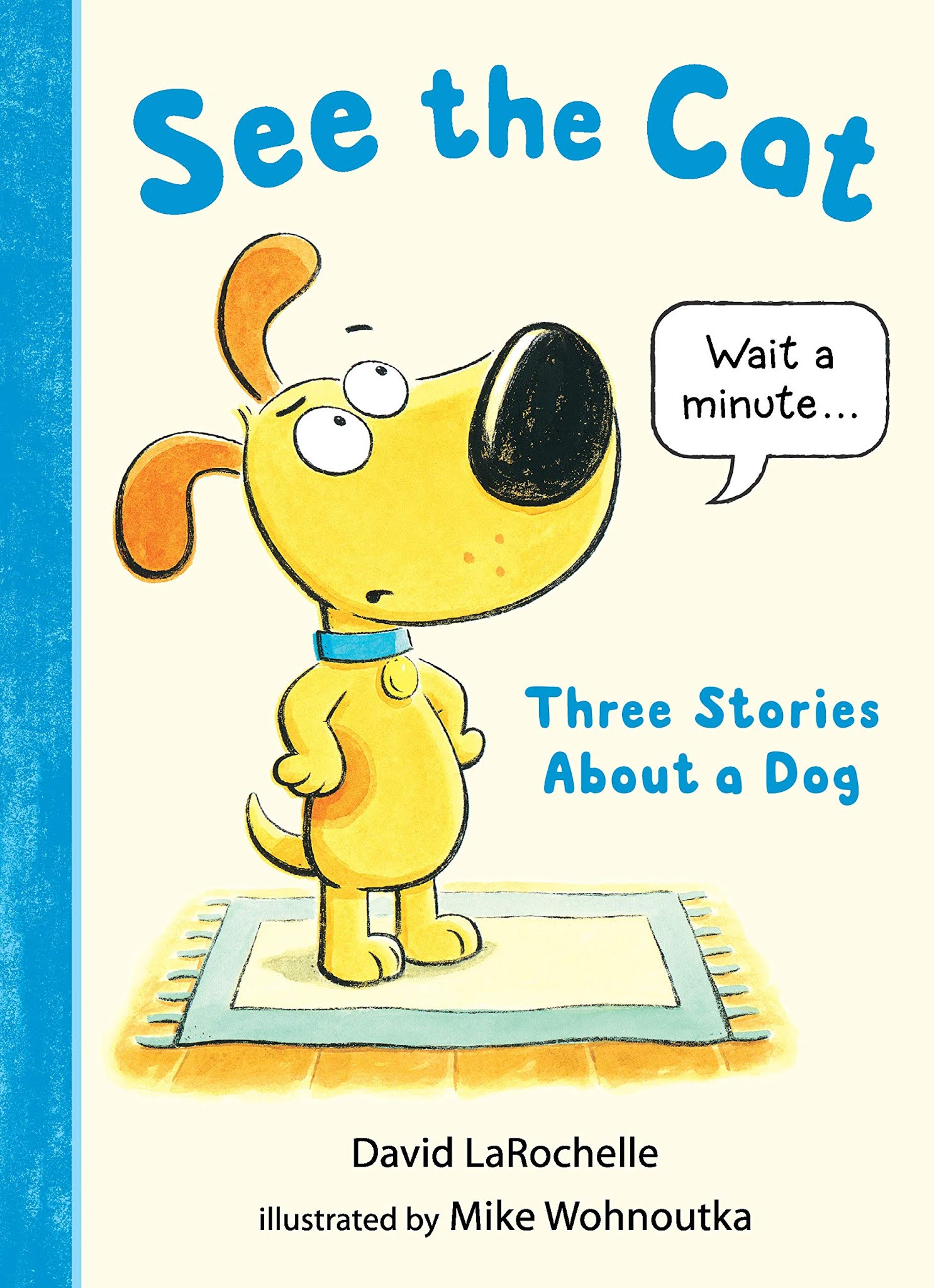
See The Cat: Three Stories About A Dog


 This book is a delight. Readers can tell right from the cover the sort of humor they are going to encounter here and this book does not disappoint. With three short chapters where the conflict between the invisible narrator and Max the dog resolves in a fresh way each time it’s the perfect length for slightly more confident young readers.

David LaRochelle and Mike Wohnoutka manage to infuse this story with originality as the long-suffering Max – who opens Story Number Two with “Here we go again.” – engages with the narration in a new way with each tale, finding increasing agency until concluding the final story with a triumphant and contented nap. Teachers may particularly enjoy the way Max uses the power of writing to change the direction of the second story.

Is this one a strong Geisel contender? The use of word bubbles, plenty of white space, and clear cartoon style illustrations are all strengths we’ve seen in previous Geisel titles. The repetition of color and animal words speaks to context readers are likely to have, leaving them better prepared to appreciate the humorous moments. The relationship between the text and the pictures is more conversational than “the illustrations providing a clue to decode the text”, but with its original take on the narrator/protagonist conflict this one is certainly worth a look by the committee.


Wednesday, December 9, 2020

Thank You

As we head into the final stretches of 2020 and end of year lists start coming out, our thoughts are with all of you and everyone who has had to reinvent the ways they do things.

We’re thankful for reviewers and listmakers, helping us discover great titles in this unusual year.

We’re thankful for parents and teachers, teaching our new readers in new ways amid trying circumstances.

We’re thankful for postal workers, under new scrutiny in this election year but still getting books to our libraries and homes.

We’re thankful for authors, illustrators, and publishers dealing with cancelled book tours and conferences as they try to share the books they’ve lovingly and thoughtfully created.

We’re thankful for ALA staff and the book award committee members – Geisel and other committees – who are facing manuals with no instructions for not being in person for award discussions or balloting.

We’re thankful for library staff everywhere, reinventing their realities with their usual commitment to public service and flexibility. This has been really hard. We see you.

We’re thankful for library selectors facing shipping delays, buildings that were closed and not receiving deliveries, uncertain future budgets, and all the other challenges this year has brought.

Whether you read one book this year or a hundred. Whether you thrived amid the uncertainty of this year or just survived. We’re thankful for you and the work you’ve done, and the work you will do in the coming year.

Thank you award committees for taking on this work in a year where few of us have any energy to spare. We’ll be cheering you on from a distance in January and can’t wait to see your choices.


Thursday, November 12, 2020

Comics Part 2

Last month our Comics Part 1 post introduced some comic contenders. This month I’m happy to bring you three more! 

Book covers for Noodleheads Lucky Day by Tedd Arnold, Martha Hamilton, & Mitch Weiss, illustrated by Tedd Arnold, 
A Pig, a Fox and a Fox by Jonathan Fenske and Pizza & Taco: Who's the Best? by Stephen Shaskan 

Noodleheads Lucky Day by Tedd Arnold, Martha Hamilton, & Mitch Weiss, illustrated by Tedd Arnold 
In 2018 Noodleheads See the Future was named a Geisel Honor. This year brings us the fifth title in the series, all about the many ways the Noodleheads accidentally change bad luck into good. Ever gullible, the brothers fall for every single one of Meatball’s tricks as they run errands for their mother and look for a kitten to adopt. All the stellar hallmarks of the series are present in this book: speech bubbled text, word repetition, clever ways of defining idioms, and humor galore. While much of the book is supportive for developing readers, there’s one section in particular that could present some challenges. When the brothers brainstorm names for their new kitten, they come up with increasingly ridiculously monikers. More familiar words like “Sky” and Cloudy” build up to “Hippopotamus”, “Blippopotamus”, “Gobbledygook”, and “Nincompoop.” That said, there’s an undeniable page-turning dynamic to this silly romp full of wordplay that certainly speaks to the award’s criteria. 

A Pig, a Fox and a Fox by Jonathan Fenske 
Pig and Fox are back for their third misadventure. Fox has a fox doll, perfect for playing tricks on Pig. As always, Pig manages to step away from each prank unscathed, while Fox is smooshed and bandaged by the end of the book. As with Geisel honor title, A Pig, a Fox and a Box (2016), Fenske brings such a wonderful sense of Seussian rhythm to the rhyming text, which helps readers predict final words in sentences. Speech bubbles are color coded and word repetition builds in the same way chapters build to the inevitable climax. The slapstick humor is augmented by fun illustrations, especially those showing pig’s porcine-inspired abode. Could Fenske snag another Geisel nod? We’ll have to wait and see! 

Pizza & Taco: Who's the Best? by Stephen Shaskan 
A new pair of friends joins the ranks of beginning reader dynamic duos in this humorous series starter. Pizza and Taco’s best friendship is threatened when their competition to be the best escalates. They extol their own virtues, give campaign speeches, and count votes, only to realize that while each one is best at different things, the one thing they are both best at is being best friends. The cartoonish illustrations use a combination of photographs of real food and digital techniques. The rest of the book seems to be a bit of a mash up as well. For instance, the font is supportive for developing readers, but the slangy language and vocabulary used might well fly over the heads of young readers. For example, Hamburger claims he’s a “write-in candidate” and later Pizza gripes, “Popular vote doesn’t count!” Personally, I have reservations about recommending a book that includes an election rife with dishonest candidates, name-calling, and outright cheating given the real-life election season we’re living through currently. But I have to say, I’ve had my fair share of conversations with K-2nd graders who absolutely love pizza and tacos, so perhaps the main characters alone will draw readers in.

Have we missed any stellar comics for beginning readers published this year? Let us know in the comments. 

Tuesday, November 3, 2020

#WeNeedDiverseBooks: Black Lives Matter

Black Lives Matter, and stories about Black lives are needed more than ever in media for all ages. Here on Guessing Geisel we’ve spoken about the need for greater diversity in books for beginning readers. While we celebrate the titles included in this post and published this year, there is certainly room across books for all ages for more diverse books, and particularly more stories about Black joy.


A newly launched series by accomplished duo author Kelly Starling Lyon and illustrator Nina Mata highlights an imaginative young Black boy, Ty, in two titles. Both feature helpful repetition to support beginning readers, and are described by the I Can Read schema as “ideal for sharing with your emergent reader”.

In All Aboard! Ty’s family is too busy to play, but once his train starts chugging along they reconsider and hop aboard! Mata’s illustrations do a delightful job of transitioning between Ty’s imagined, crayon-rendered landscape and more realistic scenes of his home.

In Zip, Zoom! Ty is learning to ride his new scooter in the park, which his imagination transforms into a crayon-rendered racetrack. Just when he is about to admit defeat, a new friend inspires him to keep going and they finish the imagined race together.

We look forward to future entries in this whimsical series.

2020 also bring additions to established series featuring Black characters, both own voices and those created by white authors and illustrators:


Christine Platt and Sharon Sordo added three titles to the Ana and Andrew Series early in the year: The Magic Violin, Going to Ghana, and The New Baby. Titles focus on African American culture and traditions and introducing readers to notable African American historical figures. In The Magic Violin, Frederick Douglass teaches Ana and Andrew the importance of practicing. In The New Baby, Granny explains to Ana and Andrew the significance of names in African American culture. In Going to Ghana the children learn about Gh anian Culture and the origins of the slave trade. For more confident and fluent readers ready to make the transition to chapter books, the Ana and Andrew series offers lessons in African American culture paired with Sordo’s joyful and vibrant illustrations. 

Dori Hillestad Butler and Nancy Meyers added a title to their Geisel honor-winning series:

In King and Kayla and the case of the Unhappy Neighbor Mr. Gary’s garden has been dug up by an unseen culprit! While Thor, Jillian’s dog is suspected, King and Kayla are on the case to clear his name. Another solid entry to a series with plenty of humor and heart, this title also features the short chapters perfect for young readers building up the confidence for longer titles. 


David Adler and Sam Ricks added two titles to their Geisel Award-winning Mo Jackson Series:

Swim, Mo, Swim! and Run, Mo, Run! which place perpetual underdog Mo Jackson in a field day swim race with extra ice cream on the line for the winning team, and track and field meet where a last minute snack brings Mo a bit of luck.  

We hope to see even more titles celebrating Black lives in upcoming seasons. 


And a resource recommendation before we go:

We recommend checking out the Kidlit Rally for Black Lives, held and recorded during Summer 2020 and hosted by The Brown Bookshelf as a resource for anyone who works with children, including parents, caregivers, librarians, and educators. Amanda attended this event live and found it profoundly informative and helpful, as well as hopeful. Follow The Brown Bookshelf for additional info about upcoming events, like a recent Black Lives Matter Q&A with authors Kwame Alexander, Jacqueline Woodson, Jason Reynolds and Toshi Reagon.

Thursday, October 22, 2020

Comics - Part One

There’s no doubt about it, comics and the Geisel Award go together like peanut butter and jelly! With honor titles like Sergio Ruzzier’s Fox and Chick: The Party and Other Stories, My Kite Is Stuck! And Other Stories by Salina Yoon, Emily Tetri’s Tiger vs Nightmare (just to name a few), and Laurie Keller’s Geisel winning We Are Not Growing!, there are a lot of comics for beginning readers to love. And yet, if your library is anything like mine, there’s a definite need for more comics for developing readers. They seem to fly off the shelves! So in today’s post I’m going to highlight a few beginning reader comics. Could one of them be the peanut butter to this year’s jelly? 

Book covers: Baloney and Friends by Greg Pizzoli, Chick and Brain: Egg or Eyeball? by Cecel Bell, Cookie & Broccoli: Ready for School by Bob McMahon

Baloney and Friends
b
y Greg Pizzoli 
Given his Geisel track record -- Watermelon Seed (winner 2014), Good Night Owl (honor 2017), Book Hog (honor 2020) --, a new Pizzoli book always generates some Geisel buzz. In a combination of longer, multi-page stories and brief, single-page mini-comics, a pig named Baloney and his gaggle of animal friends support one another through swimming pool fun, magic show hilarity, and days when they’re feeling a bit blue. Color-coded speech bubbles match the color of each character, making it easy to follow the dialogue-driven stories. Although there’s occasional unfamiliar vocabulary and a word here and there printed in a decorative font, overall there’s much to appreciate in what promises to be the start of a new series. 
 
Chick and Brain: Egg or Eyeball? by Cece Bell 
Just last year Bell took home a Geisel honor for Chick and Brain: Smell My Foot. All the supporting elements from that honor title -- clever word repetition, a story arc that creates a wonderful page turning dynamic, and text printed in an easy to read font positioned in well-placed speech bubbles -- are once again present in the duo’s newest adventure. In four chapters of hilarious wordplay, Chick and Brain debate egg versus eyeball with an eleventh hour reveal that will have everyone giggling. Readers of the first book will be delighted to encounter Spot the dog, as well as a few new, completely original characters. While there are definitely nods to the first book, this title stands on its own quite well. 

Cookie & Broccoli: Ready for School! by Bob McMahon 
Starring a cast of talking foods with stick-like appendages and large expressive eyes, McMahon’s author-illustrator debut is jam-packed with jokes. From the first moment Cookie and Broccoli meet at school, it’s clear they are destined to become best friends whose opposite personalities complement one another. School day mischief and misunderstandings provide the backbone for this series starter. While the silly humor and friendly illustrations scream kid appeal, the sheer amount of text along with the many different decorative fonts used throughout the book may pose some barriers to a successful reading experience for new readers. 
 
As I close this post, I want to highlight the need for developing reader comics by BIPOC creators, as well as creators with/from other marginalized identities and communities. And we need those identities and cultures to be reflected in the books as well. Have you noticed something all of the titles mentioned in this post have in common? They all feature animals, plants, or other inanimate objects (with the exception of Brain, who is a walking, talking brain…), rather than human characters. I long for comics that provide windows, mirrors, and sliding glass doors to new readers. That’s not to say that any of the titles or creators we’ve mentioned in this post aren’t Geisel-worthy, rather, let’s take note of these gaps. Make your voice heard by asking publishers to actively seek, publish and promote diverse comics by diverse creators.

Thursday, October 15, 2020

And We're Back!

 What a year 2020 has been, right? Everything seems to have changed, from the way we check out library books (did anyone think curbside pickup would be the major trend this year?), to the way we do school (gentle, virtual hugs to all you teachers out there), to the way we buy groceries.  But one thing hasn't changed: kids are still learning to read, and they still need great books to help them on their way.

This year on Guessing Geisel, we're scaling back a little (which is why you're seeing this post in October instead of August), but we still want to bring you quality content to help you serve the beginning readers in your life. This year, you'll see more posts with groupings of titles, including diverse books, titles from previous Geisel winners, comic-style beginning readers, and so much more. We'll pick our favorites near the end of the year, and we'll all be watching the virtual YMA press conference in January!

Keep an eye out for new content starting next week.  Stay safe, stay healthy, and we'll see you here soon!