Pages

Showing posts sorted by date for query charlie and mouse. Sort by relevance Show all posts

Friday, October 15, 2021

Charlie and Mouse Lost and Found by Laurel Snyder


 Charlie and Mouse are back in a 5th book in the series, exploring themes of Lost and Found. Laurel Snyder and Emily Hughes received Geisel Gold in 2018 for the initial entry to the Charlie and Mouse series, about which the committee chair that year compliment the "authentic dialogue, thoughtfully repeated phrases, and distinctive illustrations". But does this latest entry have what it takes to catch the committee's eye? It is tough but not impossible for a series to earn repeat recognition - just take a look at Mo Willems' Elephant and Piggie series. Are the charming Charlie and Mouse among the "most distinguished" again this year?

The opening story jumps right into the repetition that makes this series such a strong choice for beginning readers, as Charlie and Mouse search all manner of "somewheres" for Mouse's missing blanket. The direct sentences give the dialogue a cadence reminiscent of Frog and Toad.

Emily Hughes' illustrations again add to the story, from a depiction of the many somewheres they're searching to the absolutely perfect representation of "nothing fun" at the opening of "Errands".

And then we have it - the ringer on every beginning reader team - a dog! While the Geisel criteria obviously don't require the presence of a dog, there's no denying the success of pups ranging from Henry and Mudge to King and Kayla and of course the protagonist of last year's Geisel Medal winning See the Cat. If connecting to a criteria, I'd say that dogs more often than not speak to "Subject matter must be intriguing enough to motivate the child to read". And with Charlie and Mouse as our examples, we see that the addition of a dog is enough to liven up the dreaded errands.

Laurel Snyder and Emily Hughes paint a clear picture of the impact of a new dog on family life (especially for poor Kittenhead), and the story finds its way to a touching conclusion with one last moment of silliness as it ends on another intriguing subject matter for kids of a certain age - dogs peeing. This story, like others in the Charlie and Mouse series makes sure to call back to the earlier stories in its conclusion - a reward for beginning readers who tackle all four stories in one go. 

This addition to the series is sure to be adored by fans (who could resist the utterly adorable Boop?) Will it be as impressive to the Geisel Committee? We will have to wait and find out. 

Thursday, January 21, 2021

2020 Contenders (and Ineligible Titles, too!)

As the Youth Media Awards (YMAs) announcement draws near we've been thinking about all the wonderful books for developing readers published in 2020. We didn't have time to blog about as many as we'd hoped, but that doesn't mean we can celebrate them! So we're using this last post before the YMAs to present you with a list of eligible contenders. And to wrap it up we'll include some of our favorite ineligible titles at the end.

While we've done our best to include as many eligible contenders as we could find, this list is in no way comprehensive. There's also no way to know what the real committee read or discussed. Perhaps this year's winner and honor titles are on this list. Perhaps none of these titles will be announced on Monday! We'll just have to wait and see. 

Did we miss your favorite? Let us know in the comments. 


Eligible Contenders

Note: Titles with an asterisk (*) are written and/or illustrated by a previous Geisel winner/honor author and/or illustrator.

Beginning Readers

Bumble and Bee (series) by Ross Burach

Bunny Will Not Jump by Jason Tharp

Charlie & Mouse Outdoors by Laurel Snyder, illustrated by Emily Hughes*

Dog Meets Dog by Bernice Myers

Duck and Cat's Rainy Day by Carin Bramsen

Come In, Zip! and For Otto by David Milgrim*

Fox Tails (series) by Tina Kügler

Fox Versus Winter by Corey R. Tabor*

Frog & Dog (series) by Janee Trasler

Horse & Buggy Plant a Seed! by Ethan Long*

Go, Go, Go by Bob Barner

Jack Books (series) by Mac Barnett, illustrated by Greg Pizzoli*

King & Kayla and the Case of the Unhappy Neighbor by Dori Hillestad Butler, illustrated by Nancy Meyers*

Layla and the Bots (series) by Vicky Fang, illustrated by Christine Nishiyama

Lunch Box Bully by Hans Wilhelm

A Pig, a Fox and a Fox by Jonathan Fenske*

Princess Truly: I Can Build It! by Kelly Greenawalt, illustrated by Amariah Rasucher

The Really Rotten Princess and the Awful, Icky Election by Lady Cecily Snodgrass, illustrated by Mike Lester

Run, Mo, Run! and Swim, Mo, Swim! by David A. Adler, illustrated by Sam Ricks*

Score One More by Marilyn Janovitz

See the Cat: Three Stories About a Dog by David LaRochelle, illustrated by Mike Wohnoutka

Shark Report (series) by Derek Anderson

Snow is Fun by Steve Henry

Testing the Waters by Jane Yolen, illustrated by Mike Moran

Ty's Travels: Zip Zoom! and Ty's Travel's: All Board! by Kelly Starling Lyons, illustrated by Nina Mata

Unlimited Squirrels: I Want to Sleep Under the Stars! by Mo Willems*

What About Worms!? by Ryan T. Higgins 

Who Ate My Book? by Tina Kügler

Who Needs a Checkup? by Norm Feuti


Picture Books

Black is a Color Rainbow by Angela Joy, illustrated by Ekua Holmes

Blue Table by Chris Raschka

The Camping Trip by Jennifer K. Mann

Round by Jennifer Ward, illustrated by Lisa Congdon

Sun Flower Lion by Kevin Henkes*

Turtle Walk by Matt Phelan

Up on Bob by Mary Sullivan*


Graphic Novels

Baloney and Friends by Greg Pizzoli*

Chick and Brain: Egg or Eyeball? by Cece Bell*

Cookie and Broccoli: Ready for School! by Bob McMahon

Noodleheads Lucky Day by Tedd Arnold, Martha Hamilton & Mitch Weiss, illustrated by Tedd Arnold*

Pizza and Taco: Who's the Best? by Stephen Shaskan

Puppy Problems by Paige Braddock


Nonfiction

Being Frog by April Pulley Sayre


Early Chapter Books

Astrid & Apollo and the Happy New Year by V.T. Bidania, illustrated by Dara Lashia Lee

Kondo & Kezumi Visit Giant Island by David Goodner, illustrated by Andrea Tsurmi

The Princess in Black and the Giant Problem by Shannon & Dean Hale, illustrated by LeUyen Pham


Ineligible Titles

If we're wrong about the eligibility of any of these titles, please let us know! 

  • All the Dear Little Animals by Ulf Nilsson, illustrated by Eva Eriksson - Swedish author and illustrator
  • Ana & Andrew (series) by Chrstine Platt, illustrated by Anuki Lopez - Illustrator born and currently living in Spain
  • Beach Day! by Candice Ransom, illustrated by Erika Meza - Illustrator born in Mexico and currently living in the UK
  • Big Shark, Little Shark, Baby Shark by Anna Membrino, illustrated by Tim Budgen - Illustrator born and currently living in the UK
  • Bug Dipping, Bug Sipping by Marilyn Singer, illustrated by Lucy Semple - Illustrator born and currently living in the UK
  • Cat has a Plan by Laura Gehl, illustrated by Fred Blunt - Illustrator born and currently living in the UK
  • Donut Feed the Squirrels by Mika Song - Exceeds the 96 page limit
  • Fairylight Friends (series) by Jessica Young, illustrated by Marie Vanderbemden - Illustrator born and currently living in Belgium
  • Fox & Rabbit by Beth Ferry, illustrated by Gergely Dudás - Illustrator born and currently lives in Hungary
  • Hound Won't Go by Lisa Rogers, illustrated by Meg Ishihara - Illustrator born and currently living in Japan
  • Houndsley and Catina at the Library by James Howe, illustrated by Marie-Louise Gay - Illustrator born and currently living in Canada
  • If You Love Books, You Could Be...by Elizabeth Dennis, illustrated by Natalie Kwee - Illustrator born and currently living in Singapore
  • Interrupting Cow by Jane Yolen, illustrated by Joelle Dreidemy - Illustrator born and currently living in France
  • It Is a Tree by Susan Batori - Author born and currently living in Hungary
  • King of the Birds by Elise Gravel - Author born and currently living in Canada
  • Sea Sheep by Eric Selzter, illustrated by Tom Disbury - Illustrator born and currently living in the UK
  • Shadow in the Woods and Other Scary Stories by Max Brallier, illustrated by Letizia Rubegni
  • Tip and Tucker Paw Painters by Ann Ingalls & Sue Lowell Gallion, illustrated by Andre Ceolin - Illustrator born and currently lives in Brazil
  • You Can Do It, Yasmin! by Saadia Faruqi, illustrated by Hatem Aly  - Egyptian born illustrator currently living in Canada

Saturday, January 11, 2020

We Have a Mock Winner (and Honors, too!)

We here at Guessing Geisel are happy to announce the official winner and honor titles for the 2020 Guessing Geisel Mock!


Book cover for Fox + Chick: The Quiet Boat Ride and Other Stories by Sergio Ruzzier
Winner: Fox + Chick: The Quiet Boat Ride and Other Stories by Sergio Ruzzier


Book covers for mock honor titles
Honors:
  • Chick and Brain: Smell My Foot by Cece Bell 
  • Penny and Her Sled by Kevin Henkes
  • Charlie & Mouse Even Better by Laurel Snyder, illustrated by Emily Hughes 
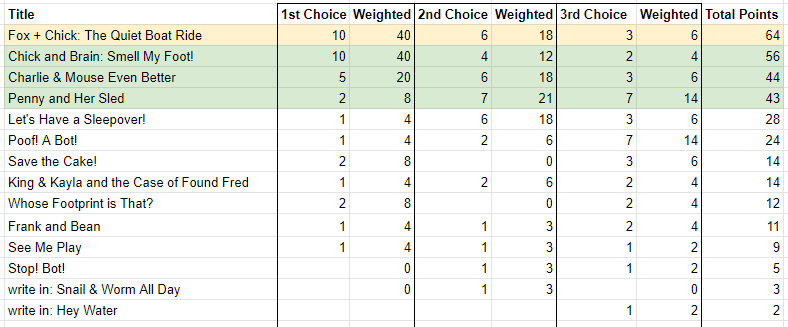
For the first time in Guessing Geisel history we arrived at our mock winner and honor titles after just one round of balloting! Using the same weighted point system as the Real Committee (4 points for each first choice vote, 3 points for each second choice vote, and 2 points for each third choice vote), we were able to clearly see our winning and honor titles. Out of 36 ballots, Ruzzier’s delightfully witty duo garnered 64 points, a full 8 points ahead of the crowd! Or, another way to look at it is 19 out of 36 people included Fox + Chick on their ballot!

As with the Real Committee, we decided there would be no limit (or requirement) for the number of honor titles to be named. Per the award manual, once a winning title has been chosen through the balloting process, the committee then turns their attention to Honor Books.
“The committee first considers whether or not to select Honor Books. If it decides there are to be none, the selection process is complete. If Honor Books are to be chosen, the selection process proceeds. At this point, certain choices present themselves:
  • Whether or not to use the winning selection ballot to choose Honor Books. The committee looks at titles with the next highest number of points. 
  • Whether or not to ballot one more time. Only one additional ballot is allowed.” 
In this case, we looked at the titles with the next highest number of points on our first ballot. All sitting between 43-56 points, each of our mock honor books were at least 15 points ahead of the next contender (Let’s Have a Sleepover at 28 points). This 15 point gap felt big enough to merit a cut off point. You can see the point tally below.


Ballot tally
Other interesting balloting results:
  • Each of our 12 contenders got at least 2 votes. 
  • Our readers also voted for two write in titles: Hey, Water! by Antoinette Portis and Snail & Worm: All Day by Tina Kügler. 
  • Fox + Chick and Chick and Brain both had 10 first place votes, but differed in numbers of second and third place votes. 
  • The mock winner and all the honor titles were created by authors and illustrators with works named Geisel Award winners or honor books in previous years. Ruzzier for the first Fox + Chick title (2019, honor), Bell for Rabbit & Robot: The Sleepover (2013, honor), Henkes has had two brushes with Geisel fame: Waiting (2016, honor) and Penny and Her Marble (2013, honor), and Snyder and Hughes took home the medal in 2018 for the first Charlie & Mouse title. 
  • For more about balloting and reballoting, check out Amanda’s previous post) 
Now all we can do is eagerly anticipate the announcement of the real YMAs on Monday, January 27, 2020, at 8 a.m. ET. We hope you'll join us in live streaming online or watching (and cheering!) in person at ALA Midwinter in Philadelphia, PA.

Friday, December 20, 2019

Our 12 Mock Geisel 2020 Contenders - Read Them Now, Vote Next Month!

This year we here at Guessing Geisel are trying something new. In the past, we would include 30+ titles on our mock ballot. While we loved highlighting so many great books for beginning readers, it could also be overwhelming. This year, with the goal of streamlining to encourage participation, we’ll be featuring just 12 titles on our mock ballot. And we’re sharing them now so you can get a jump start on reading them before voting begins in January, 2020.

Wishing you could have in-person discussions about these titles? Want to introduce your colleagues/patrons/students to excellent books for beginning readers? We encourage you to visit your local library, check out the titles, and share them. Here are a few ideas:
  • Put them on a table in a common area. Send out an email to invite colleagues to explore titles at their leisure. 
  • Make a display and encourage patrons to read them and provide feedback (written or verbal). 
  • Share them at a staff meeting. Take a couple quick minutes to tease the books or spend a longer chunk discussing a handful of titles and invite others to explore the other titles later. 
  • Host a mock with your colleagues, patrons, or students. Take a look at past posts from Patrick Gall, DaNae Leu, and Amanda Foulk, as well as our guest post for SLJ, for ideas. 

Without further ado, here are the 12 Guessing Geisel 2020 mock titles listed in alphabetical order by author. 
*Don’t see your favorite on this list? Let us know in the comments! You’ll also be able to vote for write-in contenders on the ballot.


Monday, December 9, 2019

#WNDB - Still Important

As we’ve discussed in previous #WNDB posts, the world of beginning readers is incredibly homogeneous. And what’s more, there are more books about animal and inanimate object protagonists than there are about human kids from diverse backgrounds. This year alone there are beginning readers featuring: 

  • Mice 
  • Fish 
  • Hedgehogs 
  • Squirrels 
  • Rabbits 
  • Hot dogs 
  • Beans 
  • Robots 
  • Invertebrates 
  • A brain with smelly feet 
  • Pasta 

Not to mention the plethora of beginning readers that feature protagonists that are assumed white.   

I’m not saying any of these books shouldn’t exist. There are reasons to love each and every one of them individually. But when we look at them as a whole, it’s obvious that #WeSTILLNeedDiverseBeginningReaders. Because what we don’t see (or see very little of) in this year’s Geisel contenders are representations of characters with diverse abilities, family structures, socio-economic situations, cultural backgrounds, as well as any representations of LGBTQIA+ characters and hardly any #ownvoices books. 

Why is this so important? In two words, reading motivation. As Gigi Pagliarulo wrote in a post from earlier this year, “This reading motivation comes from several areas, including choice and personal relevance. Kids who can self-select books that reflect their interests and life experiences demonstrate more reading motivation. This is where diversity and equity in beginning readers come into play.” Being able to hand a kid a book with a character that reflects their experience is affirming and validating. And for kids from dominant cultures, reading a book with a protagonist from a non-dominant culture widens their view of the world and subverts the idea that stories/life are centered around dominant culture experiences and stories. 

One book/series about a particular diverse representation isn’t enough. We need lots of books with diverse representations at all stages of the learning to read process. As Amanda Foulk wrote in a post from last year, “There’s room on our shelves for so many more types of readers to see themselves reflected at every age and stage of learning to read.” We need to be able to give kids stacks of books that provide windows, mirrors, and sliding glass doors. We cannot and should not expect a handful of books to pull that weight. 

I appreciate books like Charlie & Mouse, King & Kayla, Ana & Andrew, Katie Woo, Ling & Ting, Meet Yasmin (although this last series is sadly not eligible for the Geisel). And I encourage our readers to champion for more diverse beginning reader titles. As Danielle Jones said in an earlier post, “The Geisel Award should be for all children, but a book has to be published for it to have a chance. Many children have yet to see themselves represented in this format. This has to change.” 

Wondering what you can do to champion this cause? Take a look at the three actionable steps Gigi laid out in her post.

Wednesday, November 20, 2019

What Kids Say - November 2019

Welcome to the third post in this year’s What Kids Say Series. This series is meant to mimic an important part of Geisel Committee members’ experience: observing while kids read Geisel contenders out loud. Unlike some kid lit awards, kid appeal and a successful reading experience are part of the criteria and definitely a part of the discussion for committees. In fact there’s a section in the award manual that encourages committee members to “Take an active role and become immersed in the world of beginning readers” [p.19] followed by a list of possible ways to achieve this goal including, “‘Adopt’ a kindergarten or first grade class and observe how children learn to read” [p.19]. 

This series attempts to achieve a similar goal, but in a blog format. Each month I send a list of three or four contenders to a half dozen of our guest contributors that are caregivers of or regularly work with K-2nd grade students. I do my best to select a variety of levels and topics for readers at different stages of the learning to read process. While each of the titles highlighted in this post will be covered by guest contributors at some point this year, the focus of this series is on the experiences and observations from kid readers and their grown-up contributors. 

Contributors can record feedback in any format, however I do provide them with a couple feedback templates (Bookmark, kid feedback sheet, grown up feedback sheet). A big shout out to Jamie Chowning, DaNae Leu, Samantha Marino, and Stacey Rattner for all their hard work sharing, observing, and collecting feedback from the kids in their lives. 

This month about 100 kids in 1st and 2nd grade participated nationwide. Most read just one or two titles. 

And now, let’s get to the books and what kids have to say about them! 

Charlie & Mouse Even Better 
by Laurel Snyder, illustrated 
by Emily Hughes book cover
Charlie & Mouse Even Better by Laurel Snyder, illus. by Emily Hughes 
The third title in this sibling duo series follows up the Geisel Award-winning Charlie & Mouse and (not honored, but still amazing) Charlie & Mouse & Grumpy. As Taylor Worley writes in her review, this title “is another warm, fuzzy, and lovely entry in the Charlie and Mouse series.” Let’s see what the 34 1st and 2nd graders who read this title had to say about it. 

Nearly all the kids said they liked the book enough to reread it or read a sequel (keep your eyes peeled for Charlie & Mouse Outdoors in 2020!), and found it easy to follow. One grown-up contributor wrote that she was surprised at how much the gentle humor engaged her child, “He laughed out loud a couple of times. I think he really identified with the sibling dynamic--he was doing voices that were just spot-on.” When she asked her child what he thought, he said it was "medium" and that he would "maybe" read another. The grown-up contributor also appreciated the episodic, yet connected nature of the books, as well as Mouse's gentle gender nonconformity. “The high-heeled white boots are a fabulous touch.” 

Speaking of humor, it was a highlight for many kids, along with the delicious pancakes and the cake Charlie and Mouse make for Mom. Nearly half the kids mentioned them in their comments: 
  • It was funny, it was interesting, and it had lots of pancakes. 
  • That the boys were asking so many things about pancakes. 
  • How they asked mom for al the pankacks [sic]. 
  • I lacke the cake [sic]. 
  • I like when the kid gav the mom the kace [sic]. 
On a similar note, two children made a point to say how much they disliked “wen the kak brnt [sic].” 

Nearly all the 2nd graders sailed through the text with little to no need for help. However, several 1st graders struggled with some of the words, including: 
  • What 
  • Help 
  • Dragon 
  • Try 
  • Present 
  • Decorate 
  • Bubble 
  • Dollars 
  • Jewel 
  • Instead 
To me, this indicates that this book hits a sweet spot for more confident developing readers who can decode more complex words, but still benefit from the other supportive elements in this title. Clearly, the real committee has plenty to discuss. 

Chick and Brain: Smell My Foot 
by Cece Bell book cover
Chick and Brain: Smell My Foot by Cece Bell 
17 kids, all 2nd graders, read Bell’s graphic novel style beginning reader starring a bird and a brain with large (and smelly) feet. Bell took home an honor in 2013 for Rabbit & Robot: The Sleepover. Let’s see how her newest book about an unlikely duo fares with our kid readers. 

The hilarity of the story was clearly a hit with many readers. “Funny interesting werd. [sic],” was one child’s summation of this title. Many kids said that the phrase, “smell my foot” along with Chick actually smelling Brain’s foot were their favorite parts of the story. Some kids loved that the dog tries to eat the bird, but other kids didn’t. A couple kids said it was both their most and least favorite parts of the book. One grown up contributor noted that her child enjoyed feeling smart while reading this book. She said, “While feeling smart is always a hit with this age group, I think he enjoyed it even more because Chick was such a know-it-all.” Only two words were called out as being challenging, “wow” and “brain.” 

“I appreciated the goofy play on the social niceties that kids this age are learning,” said one of our grown up contributors. Perhaps the real committee will appreciate that too? Only a few more months until the YMAs when we’ll find out! 

See Me Play by Paul Meisel
See Me Play by Paul Meisel 
28 kids in 1st and 2nd grade read Meisel’s fourth canine-driven adventure. As Ashley Waring writes in her round up of summer Holiday House titles, “Meisel’s ability to tell such an engaging and amusing story with limited words is impressive.” 

As the book with the lowest level of text complexity on this month's list, it’s no surprise that several kids commented on how easy it was to read. One kid, who didn’t need any help with the text, proudly wrote, “I din it mess up [sic].” Although most kids didn’t need help decoding any words at all, “fast”, “wants”, “drops”, and “ball” proved a bit of a challenge for some. 

Dogs, as always, are rich with kid appeal, as noted by several kids in their comments, “I lac the dogs [sic].” And the fact that the dogs don’t get the ball at the end of the story was cited by several kids as their favorite part. One child wrote, “I like wene the bird stels the ball” [sic]. Another wrote, “I like the caritr [character]. I like the ilistrashin [illustration]. I like it all.” Nearly all the kids said the book was enjoyable with only a few saying they wouldn’t read a sequel. 

Meisel took home Geisel honors for I See a Cat (2018) and See Me Run (2012). Will See Me Play snag another honor or even the medal? 

Motor Mouse by Cynthia Rylant, 
illustrated by Arthur Howard
 book cover
Motor Mouse by Cynthia Rylant, illus. by Arthur Howard 
Rylant and Howard are no strangers to the Geisel, having won the very first medal in 2006 for Henry and Mudge and the Great Grandpas, along with an honor in 2015 for Mr. Putter & Tabby Turn the Page. Let’s see what our 48 readers, mostly 1st graders and a few 2nd graders, thought of Motor Mouse. 

The kids had a lot to say about the characters and the food (are we sensing a theme this month?): 
  • I lik it when they tride pie [sic]. 
  • I like wen he makes the cake [sic]. 
  • Telly standing on his head. 
  • I liked the last page with the friends. 
  • I liked when they learned how to share. 

About 25% of the kids needed help 1-10 times while reading this book. The large vocabulary also proved a bit daunting for some with the following words called out as difficult to sound out: 
  • Cabbie 
  • Valentino 
  • Trimmed 
  • Well 
  • Way 
  • Tune 
  • Thought 
  • Deliveries 
  • Invited 
  • Shouted 
  • South 
  • Beside 
  • Arrived 
  • Waking 
  • Point 
  • Nearby 
  • Sign 
  • Handkerchief 
Along with a large vocabulary, this title didn’t seem to have the same kid appeal as other titles on this list with 15 kids saying they either didn’t enjoy the book or wouldn’t read a sequel or both. How will this year’s Rylant and Howard collaboration fare with the real committee? We’ll just have to wait and see! 

-----------------------------------------------------------------------------------------------------------------------------------------------
So that’s what kids have to say this month! What are your kids saying about these books? Let us know in the comments. We also invite you to share kid feedback on any of the titles we blog about via the comments.

Friday, October 18, 2019

Beginning Readers, Diversity and Reading Motivation

Gigi Pagliarulo
This week's guest contributor is Gigi Pagliarulo, a librarian for the Denver Public Library. Gigi is especially interested in youth services, early literacy, and issues of diversity and multiculturalism within children's literature and programming, has served on the steering committee of Colorado Libraries for Early Literacy, and the CLEL Bell Picture Book Award Selection Committee.

Hello, and welcome to another edition of Guessing Geisel + #WeNeedDiverseBooks = #WeNeedDiverseBeginning Readers! Over the last few years, I’ve written for Guessing Geisel about a variety of issues related to diversity and beginning readers, including why we need diverse beginning readers, #EverydayDiversity and #OwnVoices.

Learning to read isn’t an easy or natural process for humans. While we evolved to talk and communicate orally, reading and writing require existing neural pathways to be repurposed in order to connect several different areas of the brain. Children need to connect how a word looks with how it sounds and what it means and then do it over and over again, stringing words into sentences and sentences into paragraphs. This is hard work and requires that children have the motivation to persist through the inevitable struggles and discomfort of the process of learning how to read. 

This reading motivation comes from several areas, including choice and personal relevance. Kids who can self-select books that reflect their interests and life experiences demonstrate more reading motivation. This is where diversity and equity in beginning readers come into play. When we review Rudine Sims Bishop’s essential piece that outlines children’s need for books to be both windows and mirrors, we can understand that seeing oneself reflected in the pages of a book (or conversely never or rarely seeing oneself reflected while reading) could strongly affect children’s reading motivation. As the International Literacy Association writes in a 2018 Literacy Leadership Brief, “For students to recognize their own communities in the books they are taught or self-select is critical to the personal engagement that drives deeper literacy.” That personal engagement is the foundational factor in reading motivation. 

The more choices available to children of diverse, self-reflective and high-quality books available, the greater the likelihood that more children will find the reading motivation they need to support their developing literacy. Unfortunately, as my prior blogs have discussed, research and experience has shown a continued paucity of children’s literature by and about people of color, people with disabilities and LGBTQ+ folks. There are but a few published each year, so here are recommendations for all the diverse, high-quality beginning readers published in 2019. If you find more, please post them in the comments. And as always, I want to remind the publishing industry that #WeNeedMoreDiverseBeginningReaders by #OwnVoices authors, and I need your help! 

Here are three ways to take action to let publishers know you want more diverse and #OwnVoices titles: 
  • Going to a library conference? Stop by publisher booths and ask a rep for their favorite upcoming diverse and #OwnVoices titles. 
  • If you do any purchasing at your library, contact your vendor and publisher reps and ask specifically for diverse and #OwnVoices. 
  • Use social media to cheer on publishers who put out diverse and #OwnVoices titles, and let them you know want more. 

Andrew & Ana series by Christine Platt, illustrated by Sharon Sordo*

Charlie & Mouse Even Better by Laurel Snyder, illustrated by Emily Hughes

Corduroy series by Don Freeman and Allison Inches, illustrated by Allan Eitzen

Garden Day! by Candace Ransom, illustrated by Erica Meza

Katie Woo series by Fran Manushkin, illustrated by Tammie Lyon

Katie Woo’s Neighborhood by Fran Manushkin, illustrated by Laura Zarrin

King & Kayla series by Dori Hillestad Butler, illustrated by Nancy Meyers

Sadiq series by Siman Nuurali*

Yasmin series bt Saadia Faruqi, illustrated by Hatem Aly*

*#OwnVoices author/illustrator

Friday, August 23, 2019

Charlie and Mouse Even Better by Laurel Snyder, illustrated by Emily Hughes

Taylor WorleyOur guest blogger today is Taylor Worley. Taylor (she/her) is a Youth Librarian at Springfield Public Library in Oregon. When she isn’t reading, she can be found drinking tea while stuck in a video game, making something with yarn, or exploring. She has two dogs, Olivander (Oliver) and Gregorovitch (Gregory). You can find her on Instagram or Goodreads @thatonelibrarian.

Charlie and Mouse are back for round three! These two adorable kids leapt onto the early reader scene in 2017 with their debut, Charlie and Mouse. Author Laurel Snyder and illustrator Emily Hughes took home the Geisel Award for that first book in 2018. Since then, readers got to know Charlie and Mouse more in Charlie and Mouse and Grumpy and now in Charlie and Mouse Even Better. Even Better is eligible for the 2020 Geisel Award, but does the third outing stand up to the legacy of the first? 

Cover image: Charlie and Mouse Even Better
Even Better is divided into four short chapters: making pancakes with Mom, gift shopping with Dad, birthday party prep and disaster, and operation “distract mom”/successful birthday celebration. This format, accompanied by Hughes’ distinct illustrations, is consistent throughout the series and is a large part of what makes the titles successful for beginning readers. The chapters are not numbered; they are simply headings that provide a key for the plot’s shifting focus. The text stays tight and straightforward with wide margins and ample line spacing. The illustrations are the epitome of sweet, with bright colors and feathery lines. Commendation must be given to Hughes for her ability to express a vast array of emotions through eyebrows alone!

With the history of the series, there is no denying that Charlie and Mouse are a great resource for beginning readers. The question here, however, is if Even Better reaches that benchmark of “distinguished” above all other beginning reader titles this year. When reading Even Better to a variety of willing participants, one thing particularly caught my attention. My youngest listeners - those entering Kindergarten in fall 2019 - very much enjoyed this title as a read-aloud. They engaged with the pictures, asked questions, and wanted to continue through each page until the end. However, an even slightly older audience quickly lost interest in this title. When surveying families, those with incoming first and second graders unanimously said, “No, my child wouldn’t be drawn to this book.” So, where is the disconnect? 

Interior image from Charlie and Mouse Even Better: Mom making pancake dragons
Charlie and Mouse are young characters, and the cover of Even Better looks, in my sample audiences’ words, “babyish”. The text, however, is more challenging. The disconnect, I believe, is in the presentation of this particular title versus its intended audience. The intended audience is just a touch older than the audience that is enjoying this title as a read-aloud. Consequently, this book struggles to find the sweet spot of “motivating independent reading” while maintaining the “page-turning dynamic.” This doesn’t mean it is a bad book by any stretch, but it does undermine the book’s ability to take home a Geisel for being the “most distinguished” beginning reader title this year.

The TLDR is that Charlie and Mouse Even Better is another warm, fuzzy, and lovely entry in the Charlie and Mouse series. It is a good resource for some, but perhaps not all, beginning readers. It should absolutely be in your libraries, but I would be surprised if it walked away with the gold this year.